Progress
Ras Malé Site by Site: What's Happening at Sites A to L
Ras Malé isn't being reclaimed as one island but as 12 sites, labelled A to L, with different contractors and very different progress. Here is what has been published about each one, and what hasn't.
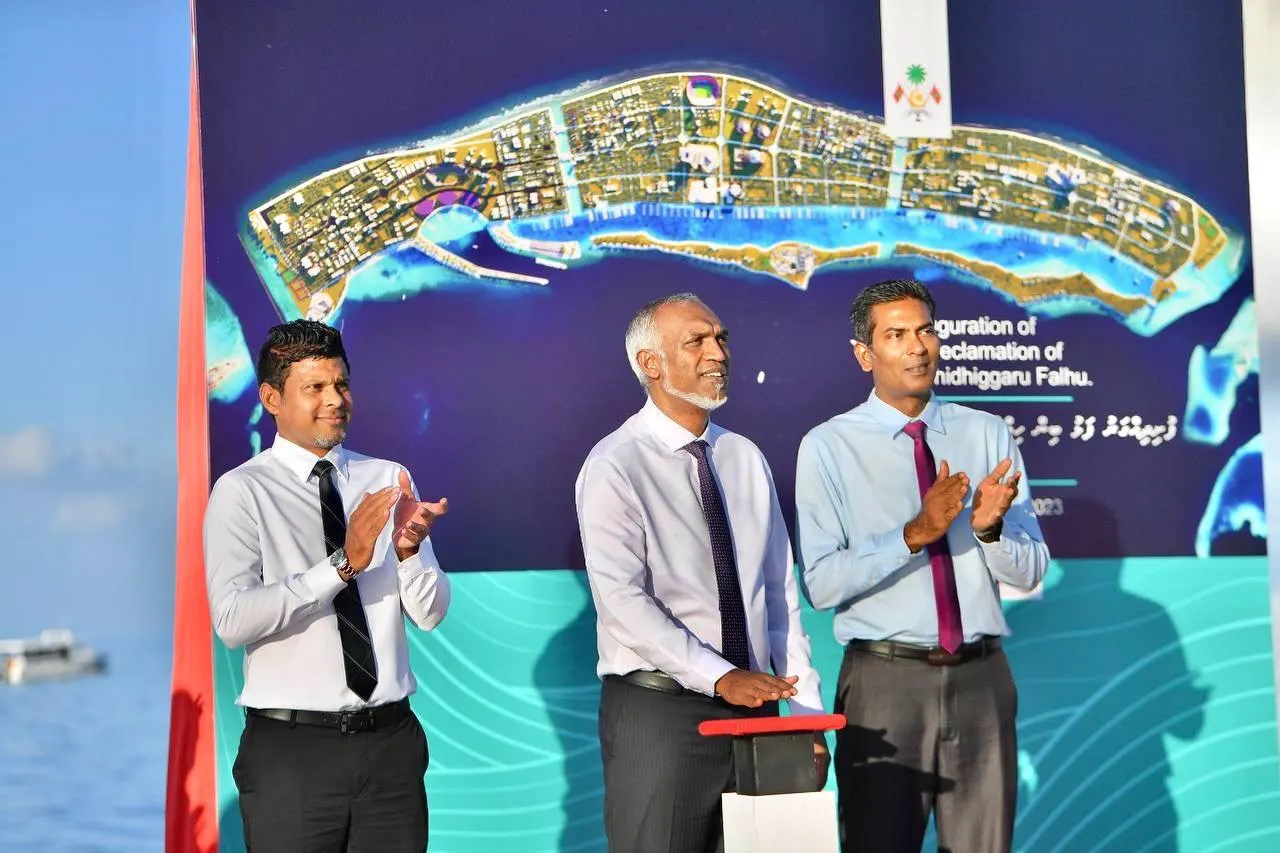
When people talk about Ras Malé's progress, they usually quote a single number, such as "about 70% reclaimed". On the ground, the city is being built as 12 separate sites, labelled A to L, across Fushidhiggaru lagoon. Each has its own planned area and contractor, and the sites have moved at very different speeds. This guide goes through them one by one, using only figures that have been published. Where nothing has been published, we say so. Our progress tracker shows the same sites on a map.
In short ⌄
- Ras Malé's 1,009 hectares are split into 12 sites, A to L, reclaimed by different contractors at different times.
- Site J (29 ha) is finished. Site A (137.5 ha) was 84% done in February 2026. Sites C and L had passed 20% by November 2025.
- Several sites, including B, H, I and K, have no published site figure.
- Overall, the government said about 70% of the land was reclaimed in September 2026.
Why 12 sites?
Splitting a lagoon this size into sites lets several contractors and dredgers work at once, and lets finished areas be protected and handed over while others are still being filled. Sites have also been reassigned as contractors came and went. In September 2024, for example, the Indian company Mohan Mutha Exports (MME) was assigned Sites D, G and L. China Railway Construction Corporation (CRCC) was assigned Sites A, B, H, I and K. Within a year, CRCC's contract had been ended and other companies were working on some of its sites. That's why older reports can name a different contractor for the same site.
The total planned land is about 1,009 hectares, according to the President's Office and HDC. The whole lagoon is larger, at about 1,153 hectares. When the site areas below are added up, they come to about 1,010 hectares without Site K, whose area hasn't been published. So the published figures don't quite reconcile.
The sites, one by one
Site J: finished
Site J was the first to be reclaimed, by the original contractor, Sri Lanka's Capital Marine and Civil Construction (CMC), in 2024. It covers 29 hectares. CMC's contract was cancelled after the work stalled, and HDC later agreed to pay US$21 million for the land it had reclaimed. In November 2025, the President's Office reported Site J as fully completed. In 2025, PSM reported it as ready for coastal protection works to begin.
Site A: the fastest so far
Site A covers 137.5 hectares. Maldives Airports Company Limited (MACL) began work there on 1 December 2025, using the Cristóbal Colón, a Jan De Nul dredger that carries 46,000 cubic metres of sand per load. Within three weeks, MACL reported 41 hectares reclaimed. By 12 February 2026, it reported 116 hectares, or 84.36%. That's the most detailed and most recent figure published for any single site.
Sites D, F, G and L: the largest group
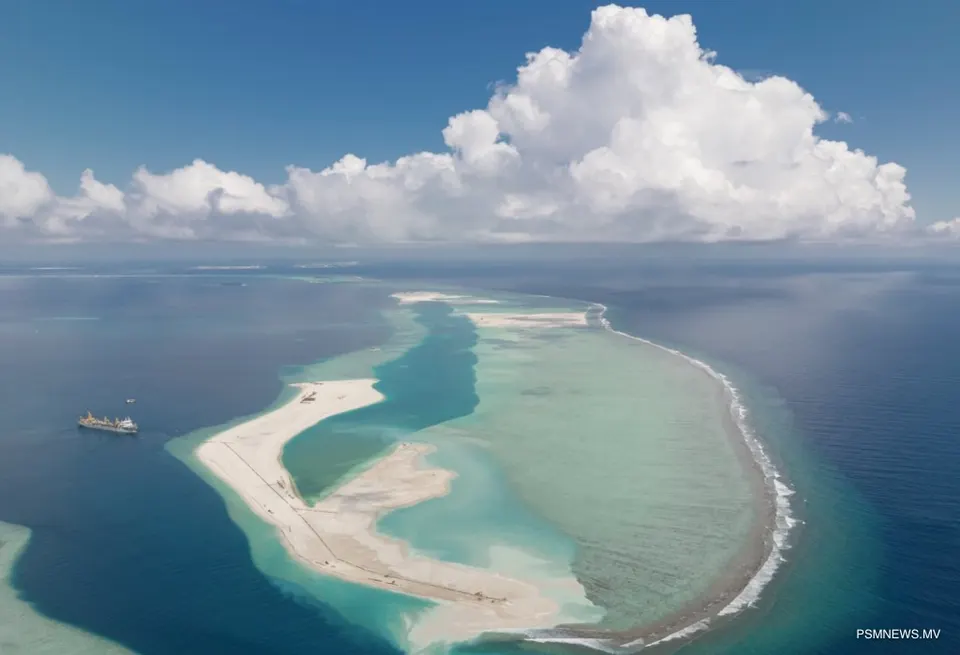
These four sites are reported together and cover about 395 hectares, the largest block of Ras Malé. They have been worked on by MME and CRCC. Reclamation restarted at Site F in November 2024, after a six-month pause following CMC's departure. By August 2025, 100.6 hectares of the group had been reclaimed, about a quarter. In November 2025, the President's Office gave Site L at 25.53%. One 2024 report gave Site D's own area as 264 hectares, assigned to MME, and described it as the only site with visible work at the time. No separate figures have been published for Sites F and G.
Sites C and E: China Harbour's sites
China Harbour Engineering Company (CHEC) signed an agreement on 2 August 2025 and began work on an extra 265 hectares: 190 hectares at Site C and 75 hectares at Site E. PSM News reported it was using the Jun Yang 1, a dredger carrying 21,000 cubic metres, about twice the capacity of the dredgers used before. In November 2025, the President's Office reported Site C at 20.09%. No figure has been published for Site E.
Sites B, H and I
These three sites cover about 183.5 hectares combined. Together with Site A, they were described in 2025 as 321 hectares scheduled for reclamation. HDC began relocating corals from Sites A, B, H, I and K so that they could be dredged. We haven't found a published figure for any of these three sites, or a confirmed current contractor.
Site K
Site K's area, contractor and progress haven't been published. It was among the sites where HDC began relocating corals before dredging, and was assigned to CRCC in 2024 before that contract ended.
How a site gets built
Each site goes through similar stages, which is why a site can look finished from the air long before anyone can build on it:
- Coral relocation. Corals in the way of dredging are moved, as HDC did before work on Sites A, B, H, I and K.
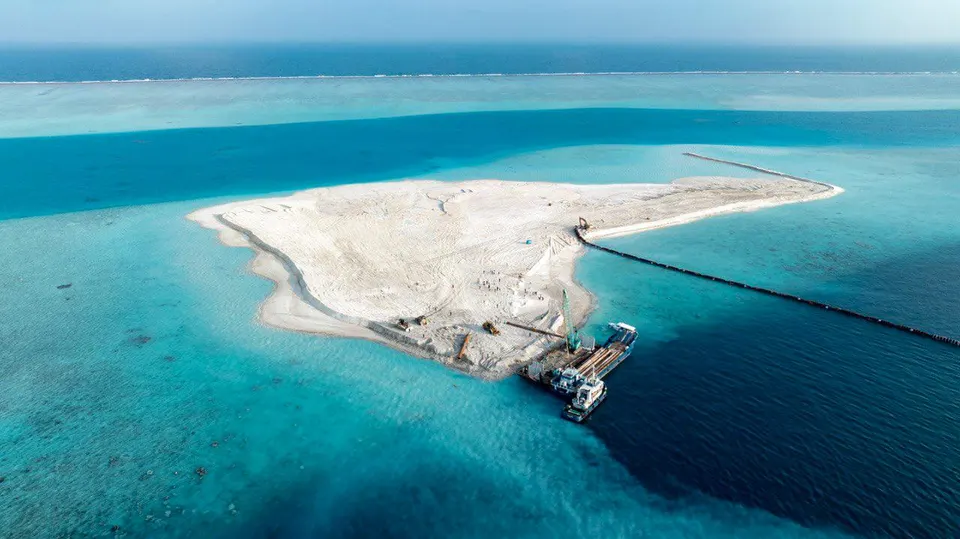
- Containment. A bund, a temporary embankment, is built around the edge to hold the pumped sand in. At Site D, satellite images in 2024 showed the bund wall advancing slowly.
- Filling. Dredgers pump sand inside the bund until the land reaches its planned height, which the government has put at 2 to 3 metres above sea level.
- Protection and settling. The edges are protected against waves, and the new ground is left to settle. Site J was described as ready for coastal protection works in 2025.
- Services. Roads, power, water and sewerage are laid. The President said in September 2026 that work on these would start before the end of the year.
Published percentages don't usually say which stage they measure. Treat a site's percentage as a measure of how much has been filled, not of whether the land is ready for homes.
Where the sand comes from
Reclamation needs enormous amounts of sand. The Environment Protection Agency permitted dredging and sand collection from two areas west of Maafushi in Kaafu Atoll, and from a third near Ithaafushi resort. The permits ran for six months and covered enough sand to reclaim 562 hectares. Before dredging, 21,641 corals were removed from affected areas and moved to coral propagation programmes at Benhaa Faru and Maniyafushi, and to several resorts. For the wider effects on the atoll, read Ras Malé's environmental impact.
The overall picture
Site figures are published irregularly, so the best measure of the whole project is the government's overall figure:
- November 2025: about 183 hectares, according to HDC
- 31 March 2026: nearly 500 hectares, with work on 11 of the 12 sites
- June 2026: about 60%, after a slowdown blamed on fuel costs
- September 2026: about 70%, with completion expected by the end of 2026
The overall figures are much higher than the site figures above, because most sites haven't had a published update since late 2025. For example, we haven't found a 2026 figure for Sites C, E, D, F, G or L, although the overall total rose by hundreds of hectares in that time.
What we're waiting for
- A full, dated site-by-site update from HDC or the President's Office.
- The area and contractor for Site K, and current contractors for B, H and I.
- Confirmation of which sites are complete and ready for coastal protection and utilities.
- A land-use plan showing which sites will hold housing plots, public facilities and the Eagle Hills waterfront district.
When any of these is published, we'll update this page and the tracker. For the overall deadlines, see our Ras Malé timeline.
Questions people ask
How many sites is Ras Malé divided into? ⌄
Which Ras Malé site is finished? ⌄
Who is reclaiming each site? ⌄
Sources
- President inspects progress of Rasmalé Land Reclamation Project · The President's Office, 2025-11-12
- EXCLUSIVE: Rasmalé land reclamation in full swing · Dredging Today, 2025-11-13
- China's CHEC joins Ras Malé reclamation as government expands contractor base and deploys mega-dredger · PSM News, 2025-08
- Rasmalé reclamation work starts with Chinese company on site · MMTV, 2025-08-21
- Rasmalé Site A reclamation reaches 84% completion · MMTV, 2026-02-12
- Rasmale' land reclamation reaches 30% completion, MACL says · MV+, 2025-12-24
- HDC to take out huge loan and hand over Rasmale' reclamation to Indian and Chinese companies · Adhadhu, 2024-09-03
- Government onboards two more Chinese companies for Rasmalé project amid ongoing delays · MV Republic
- HDC begins coral relocation to dredge more areas for Rasmale' project · PSM News
- EPA permits dredging of two areas for land reclamation of Rasmale' · PSM News
- Land reclamation resumes at Rasmalé · Dredging Today, 2024-11-12
- CMC settlement for Rasmale Site J · Adhadhu, 2025-01-26
- Housing for All initiative: Rasmalé project reclaims nearly 500 hectares of land · Dredging Today, 2026-03-31
- Ras Malé project will proceed, no foreign land ownership: President · Atoll Times, 2026-09-26
- President Muizzu launches Maldives' largest-ever land reclamation project 'Ras Malé' · MV Republic, 2023-12-18