Explore Nearby
North Malé Atoll's Local Islands: Huraa, Himmafushi, Thulusdhoo and Dhiffushi
North of Malé, four inhabited islands have become popular with visitors who want something other than a resort: royal Huraa, surf-town Himmafushi, the atoll capital Thulusdhoo, and far-flung Dhiffushi. Here is how they compare and how to reach them.
Malé sits at the southern edge of North Malé Atoll, and a string of inhabited islands lies within easy reach to the north and east. Four of them have become popular with independent travellers since 2009, when the government allowed guesthouses on local islands: Himmafushi, Huraa, Thulusdhoo and Dhiffushi. They're in the opposite direction from Ras Malé, which is being built to the south. This guide compares them, using 2022 census figures and published sources. Check transport times and prices before you travel, because they change.
In short ⌄
- Huraa, Himmafushi, Thulusdhoo and Dhiffushi are inhabited islands in North Malé Atoll, between about 16 and 37 km from Malé.
- Huraa gave its name to the Maldives' last royal dynasty and has a protected mangrove. Himmafushi is next to the Jails surf break.
- Thulusdhoo is the capital of Kaafu Atoll and a base for surfers. Dhiffushi is the easternmost inhabited island in the Maldives.
- All are reached by public ferry or shared speedboat from Malé. Local islands are alcohol-free, with dress codes outside tourist beaches.
Himmafushi: the surf island
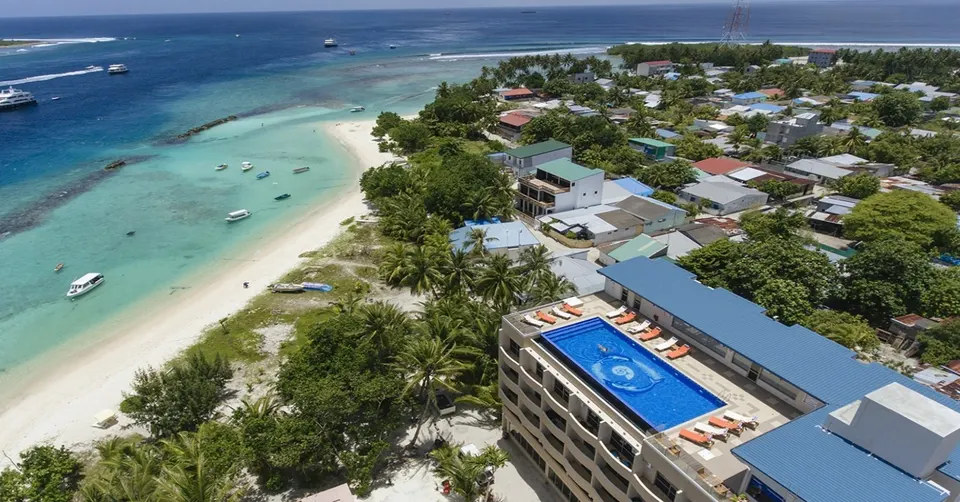
Himmafushi is about 16 km northeast of Malé, around 18 km from the airport, and can only be reached by boat. It had 2,012 residents at the 2022 census, up from 1,334 in 2014. The island has its own fish processing company, a boat-building yard and a water bottling plant.
For surfers, Himmafushi is known for Jails (also called Jailbreaks), a walled right-hand reef break a short boat ride off the island. It's one of the most popular breaks in the atoll. See our guide to surfing near Malé.
Huraa: the royal island
Huraa lies about 20 km northeast of Malé. It's roughly 850 metres long and 300 metres wide, and had 1,654 residents in 2022, up from 1,014 in 2014. Residents mostly work in fishing and tourism, and tourism has grown since guesthouses opened.
Huraa has a special place in Maldivian history. It's the origin of the Huraa dynasty, the last royal dynasty to rule the Maldives, founded in 1757 by Sultan al-Ghazi Hasan 'Izz ud-din. North of the island is a mangrove swamp, a protected nature reserve that gives resting habitat to protected birds. An IUCN study recorded ten kinds of trees there, including true mangroves. It's a rare chance to see a different side of Maldivian nature from the usual beaches and reefs.
Thulusdhoo: the atoll capital
Thulusdhoo is the capital of Kaafu Atoll, the administrative atoll that includes Malé. It's about 27 km northeast of Malé, roughly 1.6 km long, with 33 hectares of land. It had 1,801 residents in 2022, up from 1,133 in 2014.
Thulusdhoo is a long-standing base for surfers. Two of the atoll's best-known breaks, Cokes, a short, powerful right over shallow reef, and Chickens, a long left, are close by. Surf guides describe Cokes as a wave for experienced surfers. Several guesthouses on the island cater to surf trips.
Dhiffushi: the far east
Dhiffushi is about 37 km northeast of Malé, and is described as the easternmost inhabited island in the Maldives. It's about 950 metres long and 200 metres wide, with 22.3 hectares of land, and had about 1,270 residents in 2022. Its guesthouse sector, which has grown since 2009, is locally run. Being further out, it may feel quieter than the islands closer to Malé.
How the islands are growing
Like the islands south of Malé, these four have grown quickly. Census figures show:
- Himmafushi: 1,007 people in 2006, 1,334 in 2014 and 2,012 in 2022, doubling in 16 years.
- Huraa: 849 in 2006, 1,014 in 2014 and 1,654 in 2022.
- Thulusdhoo: 1,148 in 2006, 1,133 in 2014 and 1,801 in 2022.
Much of the recent growth came between 2014 and 2022, the years when guesthouse tourism took off on local islands. These figures include foreign residents.
Getting there
None of the four has an airport or bridge. You reach them by sea from Malé:
- Public ferry: MTCC runs public ferries from Malé to North Malé Atoll's islands. They're cheap but slow. For Dhiffushi, the trip takes about 2 to 3 hours. Check whether your route runs on Fridays, as Friday services are limited.
- Shared speedboat: faster and more expensive. For Dhiffushi, a shared speedboat takes about 40 to 45 minutes and cost around US$35 per person, as reported. The closer islands are quicker.
- Guesthouse transfers: many guesthouses arrange airport pick-ups, which saves crossing to Malé first.
Public ferries leave from Malé, not the airport. Confirm the day's timetable with MTCC or your guesthouse.
What to do
- Surf at Jails, Cokes, Chickens and other North Malé breaks, mainly from about April to October.
- Snorkel and dive on the atoll's reefs, including protected marine areas such as Banana Reef and HP Reef. Go with a licensed operator.
- Visit the Huraa mangrove, a protected reserve, respecting any rules on access.
- Sandbank and picnic trips, offered by most guesthouses.
- Day visits to resorts, several of which are close to these islands.
For more ideas, see our day trips from Malé.
When to go
The drier northeast monsoon usually runs from about December to April, with calmer seas. The wetter southwest monsoon runs from about May to November, with more rain and bigger swells. For surfers, the most consistent waves come between about April and October, with March and November quieter transition months. For calm snorkelling and sandbank trips, the drier months are usually easier, but trips run all year when the weather allows.
Island-hopping
Because the islands are close together, you can combine them. A common plan is a few nights on Thulusdhoo or Himmafushi for surfing, then Huraa or Dhiffushi for a quieter stay. Speedboat transfers between islands can usually be arranged through guesthouses. Public ferries mostly run to and from Malé, so check the route before relying on them to hop between islands.
The reefs: a word of caution
North Malé Atoll's reefs are under pressure. In February 2026, the Maldives Independent reported that dive operators found the "shark tank" site near Hulhumalé murky, with fewer shark sightings, and that Kurumba's house reef and Banana Reef were in poor condition. The report linked the murky water to sediment from dredging for Ras Malé and Hulhumalé. Ask your operator which sites are in the best shape, and avoid touching or standing on coral. Our article on Ras Malé's environmental impact has more.
Staying safe
- Surf breaks like Cokes break over shallow reef. Know your level, and go with a guide if you're new to reef breaks.
- Channels between reefs can have strong currents. Snorkel with an operator who knows the site.
- Wear reef-safe sun protection, and drink plenty of water in the heat.
Local customs
- Dress modestly in the village, with shoulders and knees covered. Swimwear is for designated tourist beaches.
- Alcohol isn't allowed on local islands.
- Respect prayer times. Shops may close briefly during them.
- Ask before photographing people.
Which island is for you?
- Himmafushi for the closest island to Malé, and Jails.
- Huraa for history, the mangrove and a gentle introduction to island life.
- Thulusdhoo for surfing at Cokes and Chickens, and a bigger island feel.
- Dhiffushi if you want to get further from the city.
For the islands to the south, near Ras Malé, see Gulhi, Guraidhoo and Maafushi.
Questions people ask
Which North Malé Atoll local island is best for surfing? ⌄
What is special about Huraa? ⌄
How far is Dhiffushi from Malé? ⌄
Is Thulusdhoo the capital of Kaafu Atoll? ⌄
Sources
- Himmafushi · Wikipedia
- Huraa (Kaafu Atoll) · Wikipedia
- Thulusdhoo · Wikipedia
- Dhiffushi (Kaafu Atoll) · Wikipedia
- Maldives surf guide: seasons, waves and trips · Perfect Wave Travel
- North Malé Atolls surf guide · World Surfaris
- How to navigate the Maldives public ferries · The Restless Beans
- President champions climate adaptation abroad as dredgers blanket atoll in sediment · Maldives Independent, 2026-02-12
- HP Reef, North Malé · Resort Life