Guides & FAQ
A Short History of Reclaimed Land in Greater Malé
Ras Malé is the latest chapter in a 60-year story. Again and again, the Maldives has made new land around its crowded capital: for an airport, a rubbish island, a new city and a port. Here is that history, project by project.
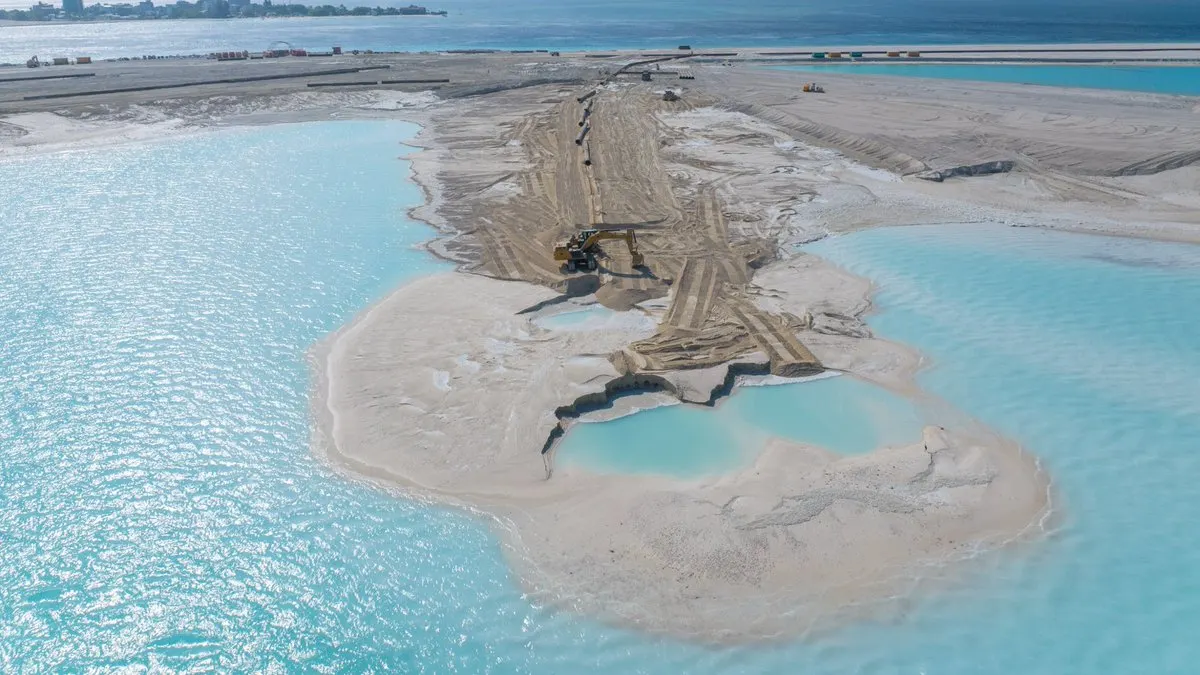
Malé island covers about 1.95 square kilometres. Its administrative area held 211,908 people at the 2022 census, and more than 40% of all Maldivians live in the capital. For decades, the only way to make room has been to make new land. Ras Malé is the biggest attempt so far, but it follows a long line of projects around the capital. This guide tells that story in order, using published sources.
In short ⌄
- Greater Malé has been growing onto reclaimed land since the airport runway on Hulhulé was built and extended from the 1960s.
- Thilafushi was made from a lagoon after 1991 as a rubbish island. Hulhumalé was reclaimed from 1997 as a new city.
- Gulhifalhu was filled between 2020 and 2024 for a new port. A new 3,400-metre runway was finished in 2018.
- Ras Malé, started in 2023, is planned at about 1,009 hectares, larger than all the earlier projects together.
1960s: an airport on Hulhulé
The capital's first airport opened on Hulhulé, the island next to Malé, on 19 October 1960, with a runway made of steel sheeting. In May 1964, Malé's residents built an asphalt runway, which opened in April 1966. First known as Hulhulé Airport and later as Malé International Airport, it was renamed Velana International Airport in 2017. It has kept growing onto reclaimed land.
Villingili: from village to resort to suburb
Not every change around Malé involved new land. Some involved moving people. In 1961, the original residents of Villingili, about 2 km west of Malé, were moved to Hulhulé to free up land near the capital. The island then housed a prison from 1962 and a resort from 1973, one of the country's first. Later it was turned back into a residential island. Today, as Villimalé, it's the fifth district of Malé City, with 6,755 residents in 2022, linked to the capital by a 24-hour ferry.
From 1988: Malé's seawall
Malé itself needed protecting. With Japanese assistance, a seawall of about 6 km was built around the island from the late 1980s. The project began in September 1988, partly by reclaiming land along the shore. When the 2004 Indian Ocean tsunami struck, the seawall was credited with greatly protecting the capital. In 2026, the government signed a contract with a Japanese company, funded by JICA, to repair and rebuild sections of it.
1991–92: Thilafushi, the rubbish island
By the early 1990s, Malé had a growing rubbish problem. On 5 December 1991, the government decided to use Thilafalhu, a lagoon west of Malé about 7 km long and 200 metres wide at its shallowest point, as a landfill. The first rubbish arrived on 7 January 1992. Pits were dug in the lagoon, filled with waste, and covered with construction debris and sand. The new island, Thilafushi, grew to more than 0.4 square kilometres. Industrial leases began in 1997, and the island now hosts boat-building, cement packing, gas bottling and warehouses. It has also drawn heavy criticism: hazardous waste mixed with ordinary rubbish led a Maldivian environmental group to call it a "toxic bomb".
1997–2002: Hulhumalé, the first new city
The first reclamation built to house people at scale began on 16 October 1997, in the Hulhulé–Farukolhufushi lagoon next to the airport. Phase 1 covered 188 hectares and was finished by June 2002. About 1,000 people moved in during 2004, the first residents of a city planned to take pressure off Malé. Phase 2 added about 244 hectares from 2015, and a third phase was being reclaimed by 2025.
Hulhumalé showed both the promise and the patience needed. By the 2022 census it had 65,714 residents. But its road link to Malé, the Sinamalé Bridge, only opened in September 2018, and its master plan has been revised several times. The latest version, in May 2025, raised its long-term target to 100,000 people in Phase 1 and 250,000 in Phase 2. Read more in Ras Malé vs Hulhumalé.
2016–2018: a new runway
Velana's growth needed more land again. A new runway, 3,400 metres long and 60 metres wide, was built by Beijing Urban Construction Group on newly reclaimed land, at a cost of about US$452 million. It was finished in September 2018, though it wasn't used for scheduled flights until October 2022. Reclamation for the airport has added about 0.62 square kilometres. A seaplane terminal opened in 2022, and a new passenger terminal in July 2025.
2020–2024: Gulhifalhu, the new port
Gulhifalhu, a lagoon between Villimalé and Thilafushi about 6 km from central Malé, was reclaimed by the Dutch firm Boskalis between May 2020 and July 2024. About 18 million cubic metres of sand were pumped in to make roughly 150 hectares of usable land, at a cost of about MVR 3 billion. It's mainly meant for a new port to replace Malé's, which would free space in the capital, with room for manufacturing and warehousing. When the Thilamalé Bridge opens, now targeted for December 2027, Gulhifalhu will join Malé, Villimalé and Thilafushi by road.
2023 onwards: Ras Malé
On 18 December 2023, President Mohamed Muizzu launched the reclamation of Fushidhiggaru lagoon, south of Malé in South Malé Atoll. It's planned at about 1,009 hectares, more than all the earlier projects together. Its story so far:
- The first contractor reclaimed 29 hectares before its contract was cancelled in 2024.
- Work resumed in November 2024, and new contractors and much bigger dredgers arrived in 2025.
- Nearly 500 hectares were reclaimed by March 2026, and about 70% by September 2026.
- In September 2026, the government signed commercial terms with Eagle Hills for a waterfront and marina on about 500 hectares.
For the full story, see the Ras Malé timeline.
What comes next
- Ras Malé: reclamation is due to finish by the end of 2026, with utilities and roads to follow and the wider city expected to take about 10 years.
- Hulhumalé Phase 3: more land next to the airport, linked to Phase 2 by filling the strip of water between them.
- The Thilamalé Bridge: 76% complete in August 2026, and due to link Malé, Villimalé, Gulhifalhu and Thilafushi by December 2027.
- The Gulhifalhu port: planned to replace Malé's port, freeing space in the capital.
What each project taught
- The airport showed that new land could transform the country's links with the world.
- The seawall showed that defending land matters as much as making it.
- Thilafushi showed the environmental cost of solving one problem fast.
- Hulhumalé showed that a reclaimed city takes decades to grow, and that links to the capital make the difference.
- Gulhifalhu showed that reclamation can free up space in the capital, not just add it.
Ras Malé will be judged on all of these: how fast it's built, how well it's protected, how much damage it does, and how well it's linked to Malé.
The scale, side by side
| Project | Started | Land |
|---|---|---|
| Thilafushi | 1991–92 | Over 43 ha |
| Hulhumalé Phase 1 | 1997 | 188 ha |
| Hulhumalé Phase 2 | 2015 | About 244 ha |
| Airport expansion | 2016 | About 62 ha |
| Gulhifalhu | 2020 | About 150 ha |
| Ras Malé | 2023 | About 1,009 ha |
For how the work is actually done, read how land reclamation works in the Maldives.
Questions people ask
When did the Maldives start reclaiming land? ⌄
Is Hulhumalé reclaimed land? ⌄
What is Thilafushi? ⌄
Which is the biggest reclamation project in the Maldives? ⌄
Sources
- Velana International Airport · Wikipedia
- Villingili (Malé) · Wikipedia
- Sea wall in the Maldives and its sustainability · National Maritime Foundation
- Practical work on Male' seawall renovation project to begin · The Edition, 2026-02-12
- Thilafushi · Wikipedia
- Hulhumalé · Wikipedia
- HDC announces changes to Hulhumale' Master Plan · The Edition, 2025-05-26
- Land reclamation · Wikipedia
- Gulhifalhu · Wikipedia
- Thila-Malé Bridge reaches 76% completion, opening targeted for December 2027 · The Standard, 2026-08-18
- Malé · Wikipedia
- Foreign money, not foreign neighbours: Rasmalé and the politics of land · Maldives Independent, 2026-10-01
- Land reclamation resumes at Rasmalé · Dredging Today, 2024-11-12
- Ras Malé project will proceed, no foreign land ownership: President · Atoll Times, 2026-09-26