Guides & FAQ
How Land Reclamation Works in the Maldives
Ras Malé, Hulhumalé and Gulhifalhu were all made by pumping sand from the seabed into shallow lagoons. Here is how that works, step by step, why the Maldives does it, and what it costs the sea around it.
Almost all of the Maldives is sea. Only about 0.3% of its surface area is dry land, and more than 40% of its people live in Malé. When the capital ran out of room, the country began making new land. The new airport runway, Hulhumalé, Thilafushi, Gulhifalhu and now Ras Malé were all built by reclamation. This guide explains how the process works, step by step, using Ras Malé as the example, and what it costs the environment.
In short ⌄
- Land reclamation creates new ground by filling shallow water, in the Maldives usually with sand dredged from the seabed.
- The main steps are permits and surveys, coral relocation, dredging, containing and filling the site, raising and settling the land, then coastal protection.
- Ras Malé is being raised 2 metres above sea level at the edges and 3 metres at the centre, to give more protection from the sea.
- Reclamation buries lagoon habitat and stirs up sediment, which is why it's controversial even as the country needs the land.
What reclamation is
Land reclamation means creating new land where there was water. Around the world, it has been done in several ways. The Dutch built dikes around wetlands and drained them to make polders. Other projects dump rock and soil into the sea until the ground rises above the water. Singapore grew its land area by about 25% between 1960 and 2019 through reclamation, and Hong Kong had reclaimed about 67 square kilometres by 2013.
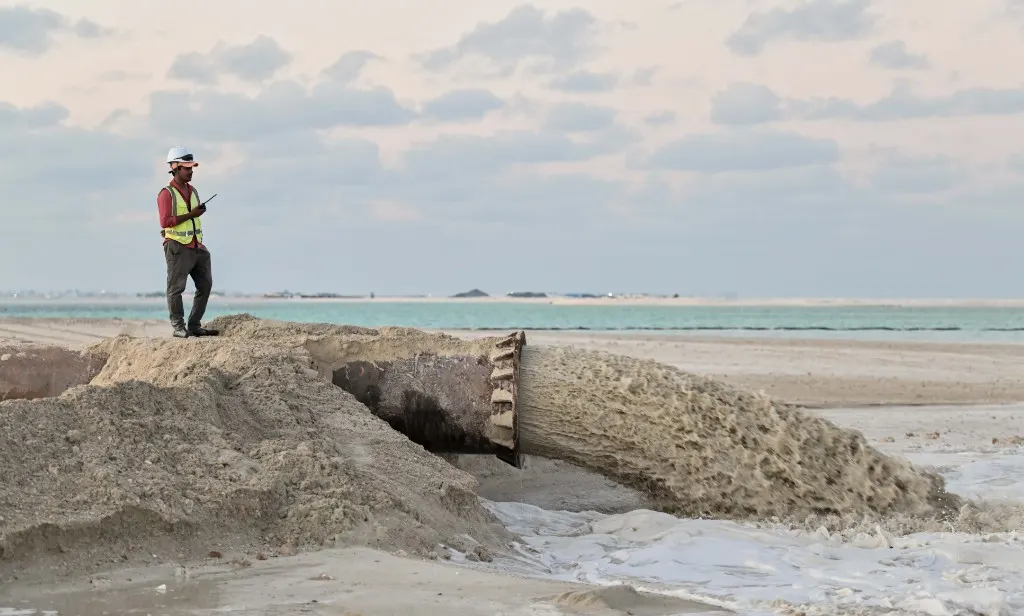
In the Maldives, the usual method is hydraulic fill. Sand is dredged from the seabed, mixed with water and pumped into a shallow lagoon until it builds up into land. The country's lagoons, shallow and protected by reefs, are well suited to this. That's why its new islands are made of bright white coral sand.
Step 1: Plans, surveys and permits
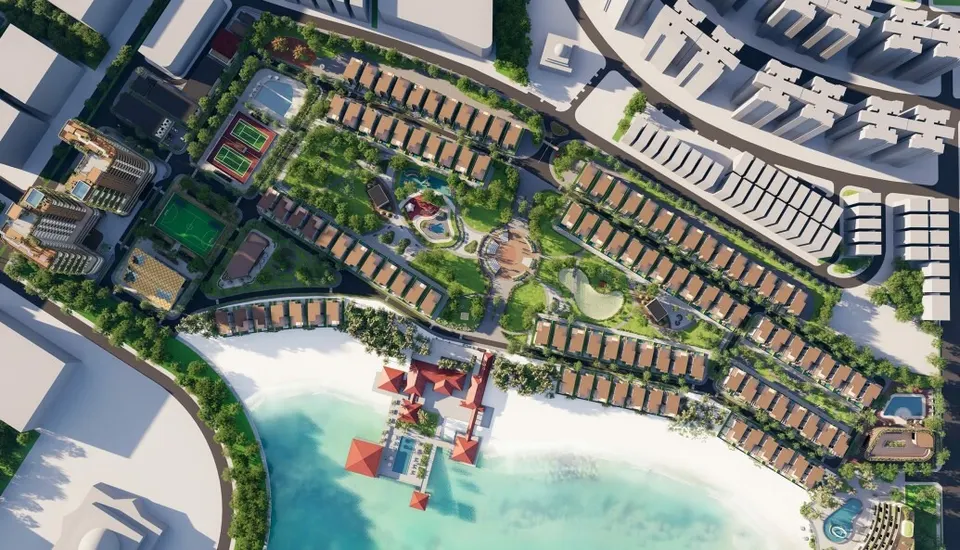
Before any dredging, the lagoon and the sand sources have to be surveyed, and the project needs environmental approval. For Ras Malé, the Environment Protection Agency issued six-month permits to take sand from two areas west of Maafushi and a third near Ithaafushi, enough to reclaim 562 hectares. Planners also decide how high the land will be and how it will be shaped into sites. Ras Malé was divided into 12 sites, labelled A to L.
Step 2: Moving the corals
Corals in the path of dredging, or in the areas to be filled, can be moved first. For Ras Malé, 21,641 corals were removed and taken to coral propagation programmes at Benhaa Faru and Maniyafushi and to several resorts. HDC also began relocating corals from Sites A, B, H, I and K before dredging them. Relocation saves some corals, but it doesn't replace the habitat that's lost.
Step 3: Dredging the sand
The workhorse is the trailing suction hopper dredger. This ship drags suction pipes along the seabed, sucking up a slurry of sand and water into its hold, the hopper. When the hopper is full, the ship sails to the site. It then pumps the sand ashore through a floating pipeline, or sprays it in a high arc onto the site, a technique called rainbowing. It does this around the clock.
The bigger the hopper, the faster the land grows. At Ras Malé, the Cristóbal Colón, which carries 46,000 cubic metres per load, took Site A from nothing to 84% complete in about ten weeks. Read more in the dredgers building Ras Malé.
Step 4: Containing and filling
To stop pumped sand washing away, a bund, a temporary embankment of sand or rock, is built around the edge of each site. Sand is then pumped inside the bund. As the slurry settles, the water drains away and the sand stays. At Ras Malé, satellite images in 2024 showed a bund wall advancing slowly at Site D before filling sped up.
Step 5: Raising the ground
Height is the point of the exercise. Most of the Maldives sits only a little above sea level, which makes it highly vulnerable to storm surges and rising seas. New land can be built higher. At the launch, the government said Ras Malé would stand 2 metres above sea level at its edges and 3 metres at its centre, which it said was above the height set for a safe island under international criteria. A 2025 report on one contract gave 2.5 metres for the reclaimed land.
Step 6: Settling and compacting
Freshly pumped sand is loose. Fill material compacts over time, and if it isn't managed, the ground can sink, a process called subsidence. Before heavy building, reclaimed land is usually left to settle and compacted, and engineers test the ground. Reclaimed land can also be vulnerable in earthquakes, when loose, waterlogged fill can behave like a liquid. That's why foundations on reclaimed land are designed for the ground conditions, and the master plan brief for Ras Malé asks for geotechnical surveys before planning.
Step 7: Protecting the coast
New land needs defending from waves. That can mean rock revetments, breakwaters, seawalls or softer measures like beaches. The official name of the work, the Rasmalé Land Reclamation and Coastal Protection Project, reflects this. Finished sites, like Site J, move on to coastal protection works.
Malé shows what coastal defence can do, and its limits. Japan helped build a seawall of about 6 km around the capital from the late 1980s, which helped protect it in the 2004 Indian Ocean tsunami. In 2026, the Maldives signed a contract with a Japanese builder, funded by JICA, to repair and rebuild sections on the eastern and northern sides. Critics argue that hard seawalls are expensive for small states, can worsen beach erosion and harm turtle nesting, and that softer measures should be used where possible.
Step 8: Services and building
Only then can the land be used. Roads, power, water and sewerage go in, followed by homes and buildings. At Ras Malé, the President said in September 2026 that work on utilities and roads would start before the end of the year. The government expects the wider city to take about 10 years.
The environmental cost
Reclamation is never free for the sea:
- Buried habitat. Everything living on the filled lagoon floor is lost. Worldwide, a 2022 analysis found that 39% of tidal wetland losses between 1999 and 2019 were caused directly by human activity.
- Sediment plumes. Dredging stirs up fine sediment that can smother reefs. In early 2026, satellite images showed plumes from the Ras Malé and Hulhumalé dredging across large parts of South Malé Atoll.
- Changed seabed. Taking sand changes the depth and shape of borrow areas. Fishermen say this has harmed bait fishing grounds.
The government's argument is that the country has little choice: it needs high, safe land for housing, and reclamation is the only way to get it near the capital. Read both sides in Ras Malé's environmental impact.
Reclamation in numbers: Ras Malé
- Lagoon: Fushidhiggaru, about 1,153 hectares.
- Land being made: about 1,009 hectares, in 12 sites.
- Started: 18 December 2023.
- Progress: about 70% in September 2026, with completion targeted for the end of 2026.
- Largest dredger: 46,000 cubic metres per load.
For a full history of reclaimed land around the capital, read a short history of reclaimed land in Greater Malé.
Questions people ask
How is land reclaimed in the Maldives? ⌄
Why does the Maldives reclaim land? ⌄
How high is reclaimed land in Ras Malé? ⌄
Is land reclamation bad for the environment? ⌄
Sources
- Land reclamation · Wikipedia
- Foreign money, not foreign neighbours: Rasmalé and the politics of land · Maldives Independent, 2026-10-01
- EPA permits dredging of two areas for land reclamation of Rasmale' · PSM News
- China's CHEC joins Ras Malé reclamation as government expands contractor base and deploys mega-dredger · PSM News, 2025-08
- HDC begins coral relocation to dredge more areas for Rasmale' project · PSM News
- Rasmalé Site A reclamation reaches 84% completion · MMTV, 2026-02-12
- Government onboards two more Chinese companies for Rasmalé project amid ongoing delays · MV Republic
- President Dr Muizzu declares that Ras Malé will develop as a zero-carbon, safe island · The President's Office, 2023-12-18
- Rasmalé reclamation work starts with Chinese company on site · MMTV, 2025-08-21
- Sea wall in the Maldives and its sustainability · National Maritime Foundation
- Practical work on Male' seawall renovation project to begin · The Edition, 2026-02-12
- President champions climate adaptation abroad as dredgers blanket atoll in sediment · Maldives Independent, 2026-02-12
- Ras Malé project will proceed, no foreign land ownership: President · Atoll Times, 2026-09-26
- Consultancy Services for the Preparation of Rasmale' Master Plan: terms of reference · Ministry of Finance and Planning, 2025-10