Invest & Buy
How 99-Year Leases Work in the Maldives
In the Maldives, almost every foreign property deal is a lease. The constitution caps leases to foreigners at 99 years, and resorts, villas and now Ras Malé's waterfront all work within that limit in different ways. Here is how the system fits together.
If you're a foreigner looking at property in the Maldives, whether it's a resort villa, a waterfront apartment in Ras Malé or a commercial plot, you'll be buying a lease, not land. The country's constitution forbids foreign ownership of its territory, so every deal is built around long leases. This guide explains how the system works, where the 99-year limit comes from, and how Ras Malé's planned waterfront fits in. It's general information, not legal advice.
In short ⌄
- Article 251 of the constitution bars foreigners from owning any part of the Maldives. Land can be leased to foreign parties for up to 99 years.
- A 2015 amendment briefly allowed foreign freehold in big reclamation projects. No land was sold, and it was repealed in 2019.
- Resorts lease islands from the state. Since 2023, resort villas can be leased to individuals on long strata leases.
- In Ras Malé, Eagle Hills plans 99-year leases that start again on every sale or inheritance, an approach critics say amounts to a sale.
The rule: Article 251
Article 251 of the Maldives constitution says that no part of the territory of the Maldives can be owned by foreigners. It allows land to be leased to foreign parties for up to 99 years. A separate article, Article 250, says state property can only be given, sold, leased or otherwise disposed of in the way the law sets out.
The rule reflects how scarce land is. Only about 0.3% of the Maldives' surface area is dry land, and more than 40% of its people live in Malé. When the one exception to the rule was repealed in 2019, the vote in parliament was unanimous.
The freehold experiment, 2015 to 2019
The rule was relaxed once. In July 2015, under President Abdulla Yameen, parliament amended Article 251. The change let foreigners who invested more than US$1 billion own land in a project where at least 70% of the land was reclaimed from the sea. The amendment passed with opposition votes.
No land was ever sold under it. After President Yameen lost the 2018 election, parliament unanimously repealed the amendment in April 2019, restoring the full ban and the 99-year limit. Ras Malé, almost entirely reclaimed from the sea, would have met the 2015 rule's reclamation test. It falls under the stricter rule that applies today.
How resorts do it
The Maldives' tourism industry runs on leases. Resort developers lease islands, land or lagoons from the state, paying rent. Lease terms have grown over time:
- In 2010, President Mohamed Nasheed's government extended resort leases to 50 years.
- In 2015, President Yameen's government extended them to 99 years.
- A 2024 amendment to the Tourism Act, the 13th, gave resorts six months to extend their leases to 99 years for a fee of US$5 million. A later amendment added instalments and a reduced-fee window.
Within a resort, the operator holds the head lease from the state, and everything else is built on top of it.
Strata villas
Since 2023, individuals have been able to take long-term leases on single resort villas. Regulation 2023/R-154, issued under the Tourism Act, lets a resort owner lease one or more villas under a strata arrangement, a share of a larger property with its own lease. Under the rules:
- The resort owner must register with the tourism ministry before leasing villas this way, and pay MVR 5,000 per villa.
- Both foreigners and Maldivians can take villas on these leases.
- Lessees get a legal right to visit the resort, but can't sub-let their villa.
- Owners who break the rules face fines starting at MVR 25,000.
Strata leasing grew under President Ibrahim Mohamed Solih's government, which also proposed a 4% tax on villa sales and then withdrew it. In November 2024, the Supreme Court ruled that sales of strata villas fall outside GST. Because strata leases sit within the resort's own lease from the state, the length of that head lease matters to every villa buyer.
Special economic zones and "sustainable townships"
The Special Economic Zones Act of 2014 created zones with their own incentives for investors. In November 2025, parliament passed an amendment creating a new category, the sustainable township, for projects worth more than US$500 million. Developers get reduced income tax: 5% for the first 10 years, then 10% for the next 10. They must also build key facilities, such as a hospitality training centre, a hospital and food-production projects. A new real estate transfer tax applies, starting at 1% and rising to 4% by a property's third transaction. Green tax, GST and land lease rent remain payable.
Large mixed-use projects of the kind planned for Ras Malé are the sort of development this category was designed for, though the government hasn't confirmed which regime will apply to the Eagle Hills district.
The Ras Malé model
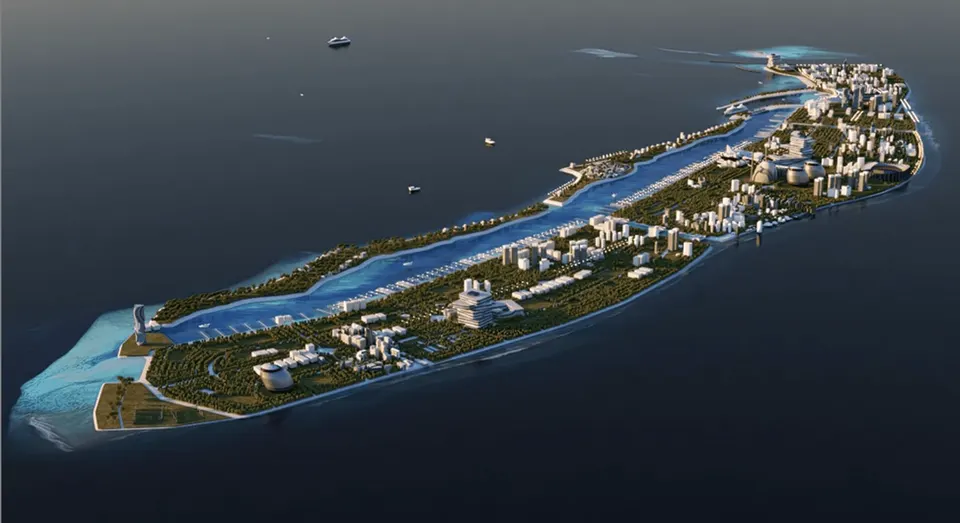
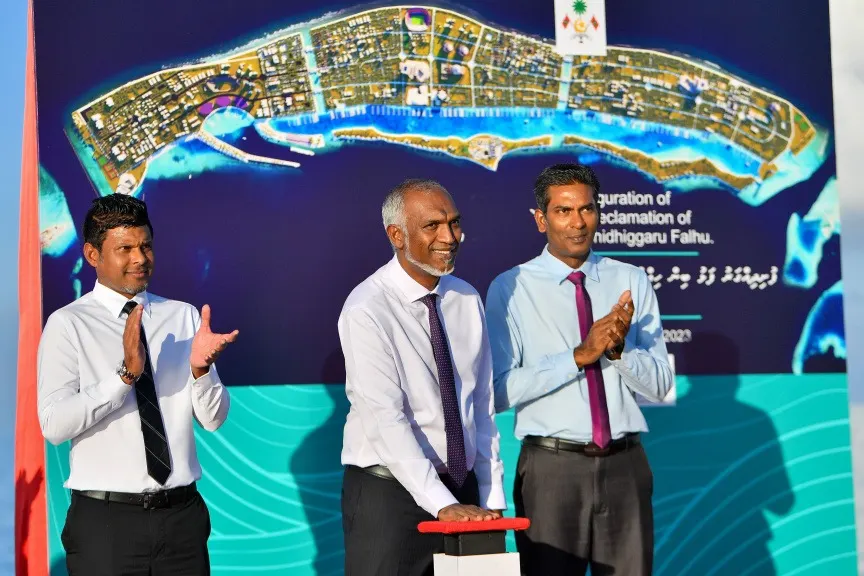
The Eagle Hills waterfront in Ras Malé takes the lease idea a step further. Under the commercial terms signed on 21 September 2026:
- Homes will be sold on leases of up to 99 years under Maldivian law. There is no freehold.
- Every sale, resale or inheritance needs government approval. The old lease is cancelled and a new lease of up to 99 years is issued.
- Each transfer pays a fee of 4% of the property's value to the state.
- Payments for off-plan homes are to be held in escrow at Maldivian banks licensed by the Maldives Monetary Authority, and resales must also go through licensed banks.
The terms of Eagle Hills' own lease of about 500 hectares haven't been published. Eagle Hills has said the lease reset applies to individual buyers, not to its own lease.
Is a resetting lease a sale?
This is the heart of the debate. Critics, including the lawyer who challenged the deal in the Supreme Court, argue that a lease that starts again at 99 years every time a property changes hands has no real end. In practice, they say, it works like ownership, getting around Article 251. The government's answer is that the land always stays with the state. It says each new lease needs its approval and pays the state a fee, so "not an inch" is being sold.
The Housing Minister has said there will be no automatic lease extensions, and that the final agreement will be subject to the constitution and laws of the Maldives. The Attorney General has said a real estate law will follow. Until those are in place, buyers can't be certain how the reset will work in law.
What this means for buyers
- Read the head lease. Your lease can't outlast the developer's or resort's lease from the state, so find out how long that has to run.
- Check what happens on resale. Is a new lease guaranteed, or does it depend on government approval? What fee is due?
- Know the taxes. Transfer fees or taxes of up to 4% can apply, plus GST where relevant.
- Don't confuse property with residency. A lease doesn't automatically let you live in the Maldives. See the corporate resident visa.
- Pay through licensed banks. For Ras Malé, off-plan payments are to be held in escrow at Maldivian banks licensed by the Maldives Monetary Authority. Be wary of paying anyone directly.
- Get local legal advice from a lawyer licensed in the Maldives before signing anything.
For Ras Malé specifically, read buying property in Ras Malé.
Questions people ask
Can foreigners own land in the Maldives? ⌄
Was foreign freehold ever allowed in the Maldives? ⌄
Can I buy a resort villa in the Maldives? ⌄
What happens when a Ras Malé lease is sold? ⌄
Sources
- 'Not an inch sold': the Eagle Hills deal and the foreign ownership question · Maldives Independent, 2026-09-23
- Foreign money, not foreign neighbours: Rasmalé and the politics of land · Maldives Independent, 2026-10-01
- Case submitted to Supreme Court to nullify agreement of Eagle Hills in Rasmalé · The Edition, 2026-09-28
- Payment made to extend three resort leases to 99 years · Adhadhu, 2024-10-12
- 15th Amendment to the Maldives Tourism Act · CTL Strategies
- Strata regulation for long-term lease of resort villas · The Edition, 2023-09-06
- President ratifies amendment to Special Economic Zone Act enabling sustainable township development · Invest Maldives, 2025-12-14
- Government statement on the Maldives Waterfront and Marina · Khulaasaa, 2026-09-30
- Eagle Hills signs $12 billion Maldives waterfront deal · Gulf News, 2026-09-21
- Minister answers MP's questions on the Eagle Hills commercial terms · Atoll Times, 2026-10
- MDP seeks disclosure of Eagle Hills pact on Ras Malé project · Atoll Times, 2026-10-05
This guide is general information, not legal or financial advice.