Invest & Buy
The Maldives Corporate Resident Visa, Explained
The corporate resident visa is the Maldives' existing route to living in the country through investment. It needs US$250,000, lasts five years and can be renewed. The government says it is the visa Ras Malé property buyers could use. Here is how it works.
Buying property in the Maldives doesn't give you the right to live there. For that, you need a visa. For investors, the main route today is the corporate resident visa, created in 2020. It has become more relevant since the Ras Malé waterfront deal, because the government says it is the visa Eagle Hills' buyers could apply for. This guide explains how it works, using the published rules and reporting on them. Rules can change, so check the current requirements with Maldives Immigration or a licensed adviser before you rely on them.
In short ⌄
- The corporate resident visa was created in November 2020 by an amendment to the Maldives Immigration Act, and its rules took effect in August 2021.
- Foreigners qualify by keeping US$250,000 in a Maldivian bank for five years, investing US$250,000 in an approved business, or holding a senior role in a qualifying foreign investment.
- The visa lasts five years, can be renewed, and covers close family. The visa fee is MVR 15,000.
- The Housing Minister says Ras Malé buyers could qualify, but that there's no route to permanent residency or citizenship.
Where it came from
The visa was created by the second amendment to the Maldives Immigration Act (Law No. 1/2007). Parliament passed it on 9 November 2020, with 53 MPs voting in favour and three abstaining. President Ibrahim Mohamed Solih then ratified it. A parliamentary committee had first proposed a threshold of US$500,000. The final version lowered it to US$250,000, which reporting at the time linked to the country's shortage of US dollars. The same amendment created a short-term meeting visa for business visitors.
The detailed rules, made under the Immigration Act, were launched on 29 August 2021.
A history of investor residency
The corporate resident visa wasn't the Maldives' first attempt at investor residency. In 2015, under President Abdulla Yameen, the government introduced a residency-by-investment route with a US$1 million threshold, alongside a corporate residency programme. The 2020 amendment, under President Solih, cut the threshold to US$250,000 and wrote the route into the Immigration Act. The same 2020 amendment also let foreigners married to Maldivians apply for residency after five years of marriage.
Who qualifies
There are four categories:
- Business owners and managers. Shareholders, directors, partners or senior officers (one of the top five managers) of a foreign investment registered in the Maldives. The business must be in good standing with its foreign investment agreement, and at least 50% of its full-time staff must be Maldivian. It must not be blacklisted under the rules on overseas workers. It must also have earned at least US$1 million in revenue in one of its last three financial years, shown in audited accounts.
- Depositors. People who keep at least US$250,000 in a fixed deposit at a bank in the Maldives for at least five years, shown by a bank statement.
- Investors. People who invest US$250,000 in a government-approved business. The government publishes which businesses are eligible, and the applicant must show the investment was made.
- Family. Parents, spouses, children, grandparents and grandchildren of someone who qualifies.
The conditions
Every applicant must meet the same conditions when they apply and while they hold the visa. These include:
- no criminal conviction, prosecution or ongoing investigation
- no domestic violence conviction or related court order
- no Interpol notice or arrest warrant
- no previous deportation from the Maldives
- no conviction for sexual offences, human trafficking, corruption or money laundering
- not being on the prohibited persons list under the Immigration Act
How to apply
- Apply through the government business portal, with the prescribed form, a personal declaration and a copy of your passport's photo page. The passport must be valid for at least six months.
- The Registrar of Business decides within 14 days.
- Within 14 days of approval, apply to Maldives Immigration and pay the MVR 15,000 visa fee.
The visa is valid for five years, and can be renewed within the 90 days before it expires. The Registrar can revoke it if the holder stops being eligible or gave inaccurate information.
What it means for Ras Malé
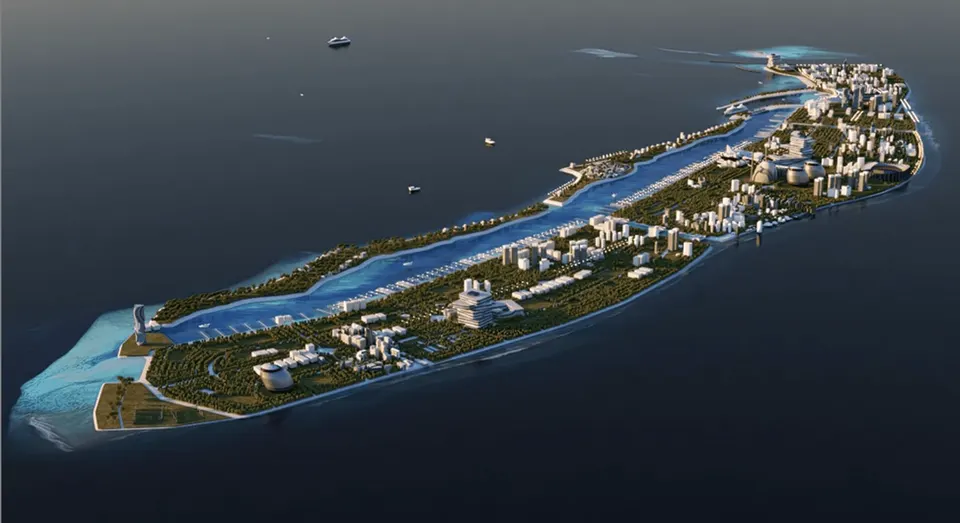
The Eagle Hills waterfront in Ras Malé plans to sell homes on leases of up to 99 years. The question many overseas buyers will ask is whether buying one lets them live in the Maldives.
The government's answer is: possibly, but not automatically. Housing Minister Abdulla Muththalib has said Ras Malé buyers would be eligible for the corporate resident visa, not for permanent residency or citizenship. He has also said the government will have the final say on who can lease property at the development and who is granted a visa. Eagle Hills' sales material has cited the visa, describing it as five years, renewable, for investments from US$250,000.
What hasn't been explained is exactly how a property purchase would fit the visa's categories. Under the published rules, the investment routes are a five-year bank deposit or an investment in a government-approved business. It isn't yet clear whether buying a Ras Malé lease will count as an approved investment, or whether buyers would also need the deposit. Until the government publishes that detail, assume nothing.
Adding up the costs
For someone hoping to live in a Ras Malé home, the visa is one cost among several:
- the property itself, sold on a lease of up to 99 years, at prices not yet published
- if the deposit route applies, US$250,000 held in a Maldivian bank for at least five years
- the MVR 15,000 visa fee, plus any fees for renewals and family members, which you should check with Immigration
- the 4% fee the government says buyers will pay on each property transfer
- legal and agent fees, and any service charges set by the developer
None of these figures has been confirmed together for Ras Malé, so treat this as a checklist rather than a budget.
What it doesn't do
- No permanent residency. It has to be renewed every five years, and can be revoked if you stop meeting the conditions.
- No citizenship. Ministers have said there's "no pathway" to citizenship through Ras Malé property.
- No land ownership. Foreigners can't own land in the Maldives under Article 251 of the constitution, whatever visa they hold. See how 99-year leases work.
The newer scheme: Pearl Residence
A separate residency-by-investment scheme, the Maldives Pearl Residence, is being developed with the firm Henley & Partners. As of October 2026, it hadn't launched, and its investment categories and terms hadn't been set. The President has said no part of Ras Malé would be included in it. In August 2026, parliament rejected an opposition motion to suspend it, which had noted that its reported threshold is similar to the corporate resident visa's. Read what we know about Pearl Residence.
Before you apply
- Check the current rules and fees with Maldives Immigration or the Registrar of Business, as the regulations can be amended.
- If you plan to use the deposit route, confirm with the bank that the account meets the five-year requirement.
- If you're buying property, ask the seller in writing how the purchase relates to the visa, and get independent legal advice.
- Remember that approval depends on the conditions above, which apply for as long as you hold the visa.
For the property side, see buying property in Ras Malé.
Questions people ask
How much do I need to invest for a Maldives corporate resident visa? ⌄
How long does the corporate resident visa last? ⌄
Does buying Ras Malé property give residency? ⌄
How much is the visa fee? ⌄
Sources
- Majlis approves to grant residency visas for foreigners with investments over USD 250,000 · Raajje.mv, 2020-11-09
- President ratifies amendment introducing corporate resident visa · Corporate Maldives, 2020-11-26
- Corporate Resident Visa rules published · Nasheed & Co
- Residents, not guests: Ayla, Henley and the Pearl visa · Maldives Independent, 2026-10-14
- 'Not an inch sold': the Eagle Hills deal and the foreign ownership question · Maldives Independent, 2026-09-23
- Foreign money, not foreign neighbours: Rasmalé and the politics of land · Maldives Independent, 2026-10-01
- Rasmalé fallout, expat assault and Soneva sale · Maldives Independent, 2026-09-27
- Parliament votes down call to halt investor residency scheme · Atoll Times, 2026-08-18
This guide is general information, not legal or financial advice.