Guides & FAQ
Gulhifalhu Explained: The Other New Island Next to Malé
Gulhifalhu was reclaimed next to Villimalé between 2020 and 2024 to take Malé's commercial port. The port has since moved to Thilafushi, and the island is now being planned for thousands of housing plots. Here is its story, and what it suggests about Ras Malé.
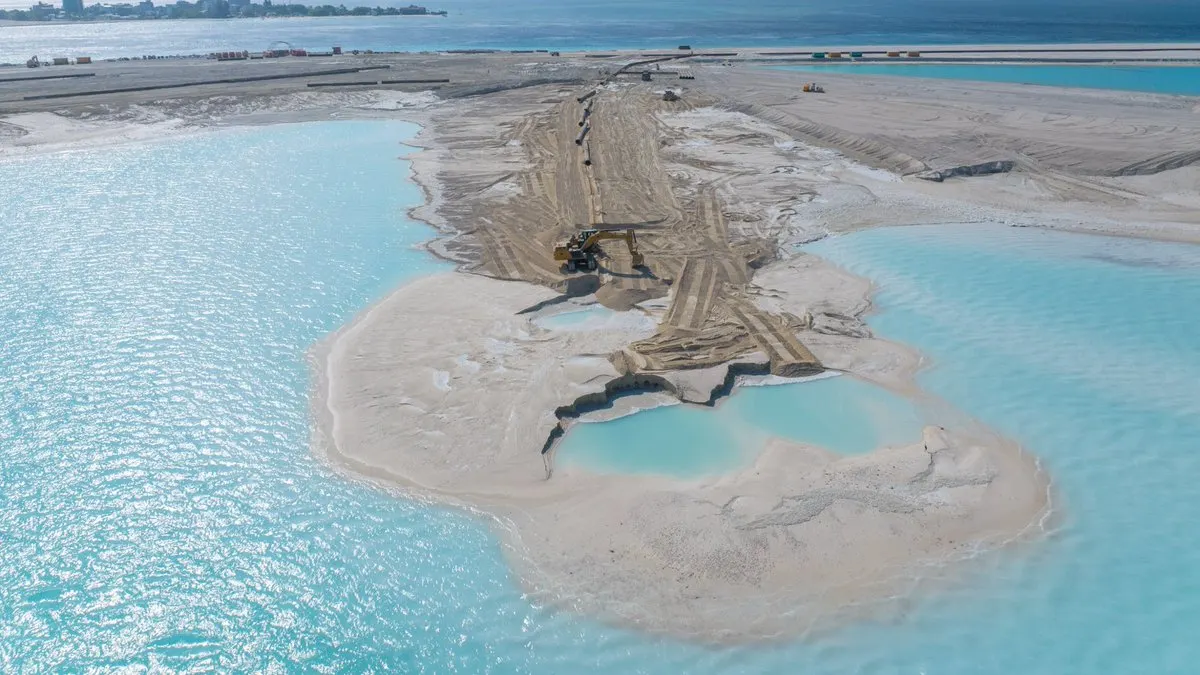
Ras Malé isn't the only new island taking shape near the capital. A few kilometres west of Malé, Gulhifalhu was reclaimed between 2020 and 2024. It was meant to take the capital's commercial port, then the port moved somewhere else, and now it is being planned for thousands of homes. Its story is worth knowing in its own right, and it offers a few lessons for Ras Malé.
In short ⌄
- Gulhifalhu is an artificial island of about 150 hectares, about 6 km from central Malé, between Villimalé and Thilafushi.
- It was reclaimed by Boskalis between May 2020 and July 2024, at a cost of about MVR 3 billion, to make room for a new commercial port.
- In 2024 the government moved the port plan to Thilafushi. More than 3,500 housing plots have since been assigned in Gulhifalhu.
- The island will be connected to Malé by the Thilamalé Bridge, which was 76% complete in August 2026 and is due to be finished by the end of 2027.
Where Gulhifalhu is
Gulhifalhu, sometimes written Gulhi Falhu, lies in North Malé Atoll, between Villimalé and Thilafushi, about 6 kilometres from central Malé. It is administered as a district of Malé City, under the Malé City Council. Don't confuse it with Gulhi, the small inhabited island in South Malé Atoll next to Ras Malé. The names are similar because falhu simply means lagoon.
It is one of a ring of islands that make up the Greater Malé area: Malé itself, Villimalé, Hulhulé (the airport island), Hulhumalé, Thilafushi and now Gulhifalhu. Our guide to living in Greater Malé today compares the inhabited ones.
What was there before
Gulhifalhu was a shallow lagoon with reefs around it. One of them, known to divers as Hans Hass Place or Kiki Reef, was a protected marine area. Reclamation destroyed it, causing a permanent loss of coral and marine habitat.
The reclamation
The idea of building on the lagoon goes back several governments. In 2018, President Abdulla Yameen announced a "mega housing project" there called Villimalé 2. The main reason for reclaiming it, though, was to build a new port to take over from the crowded commercial harbour in Malé, freeing space in the capital for redevelopment.
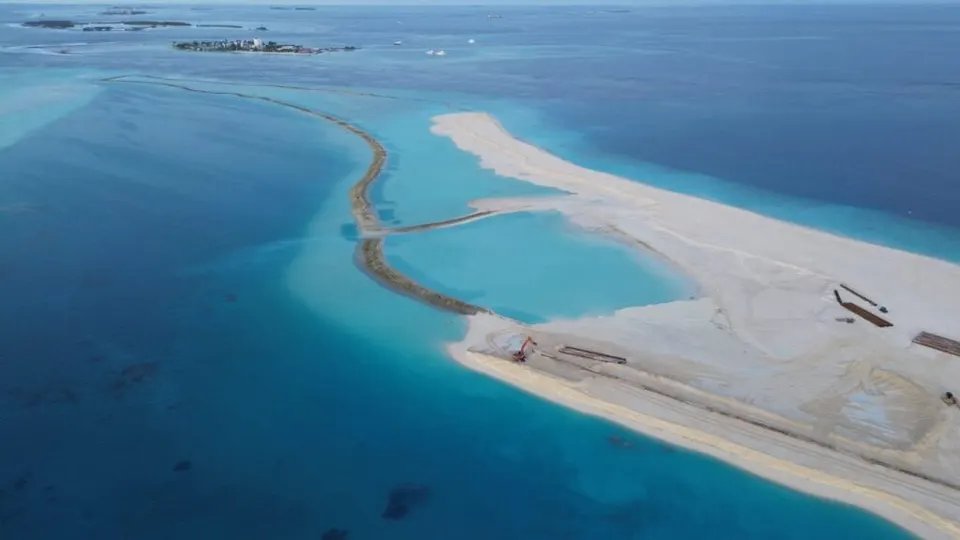
Reclamation began in May 2020. The Dutch company Boskalis pumped about 18 million cubic metres of sand into the lagoon, creating about 150 hectares of usable land at a cost of about MVR 3 billion. The work was completed in July 2024.
The project was controversial from the start. The contract was awarded without formal tendering, six months before the environmental impact assessment, which warned of potential irreversible environmental damage. In 2021, the environmental activist Humaidha Abdul Ghafoor won a High Court injunction to halt the work. In 2024, the Supreme Court overturned it.
The port that moved
Gulhifalhu's original purpose was the Greater Malé commercial port. The new port was to be financed largely by India, with an Indian line of credit covering 75% of the cost, estimated at about US$400 million, and a capacity of 400,000 twenty-foot containers.
In early 2024, President Mohamed Muizzu announced that the port would instead be built on Thilafushi, saying Gulhifalhu was not the most appropriate site. That decision changed Gulhifalhu's future. An island made mainly for a port became an island looking for a new main use.
From port to housing
Housing has filled the gap. Under the previous government's Binveriya scheme, thousands of Malé residents had been promised land plots in Hulhumalé, Gulhifalhu and Giraavarufalhu. The current government has kept many of those allocations and moved some of them to Gulhifalhu.
- The housing ministry held a draw at Dharubaaruge in which 3,520 land plots in Gulhifalhu were assigned.
- The draw included people who had received land under Binveriya, people still waiting for allocations, and people whose plots were moved from Giraavarufalhu. Raajje.mv reported that 1,337 plots had been transferred from the Giraavarufalhu allocation.
- Plots will be formally handed over after the Thilamalé Bridge is completed. At the time of the draw, the ministry said land made by dredging couldn't yet be registered under the regulations, so recipients would receive a document instead.
Recipients are notified by SMS and through the government's Hiyavahi online portal, where block numbers, plot numbers and allocation plans are published. Until the new Thilafushi port is built, the capital's existing commercial harbour stays in use.
The plan has changed several times. The land use plan has been amended repeatedly, and in May 2025 critics complained about a lack of transparency, the absence of beaches or similar public spaces in the amended plan, and delays in distributing the plots. Registrations began in 2025. By August 2025, the housing ministry said 843 people had received land registrations, covering about a quarter of the land allotted under Binveriya in Gulhifalhu.
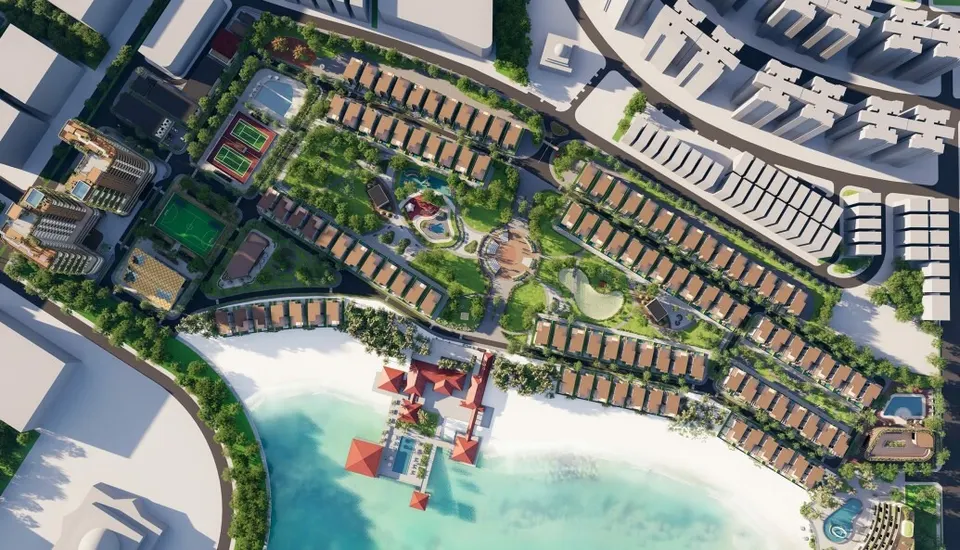
Gulhifalhu is also expected to keep industrial, warehousing and distribution uses alongside housing. A technical analysis commissioned by the Malé City Council, reported by the Maldives Independent in 2025, was sharply critical of an earlier high-density housing plan for the island.
The Thilamalé Bridge
Gulhifalhu's future depends on a bridge. The Thilamalé Bridge will link Malé to Villimalé, Gulhifalhu and Thilafushi. It is being built by India's Afcons Infrastructure and financed by India through a US$100 million grant and a US$400 million line of credit.
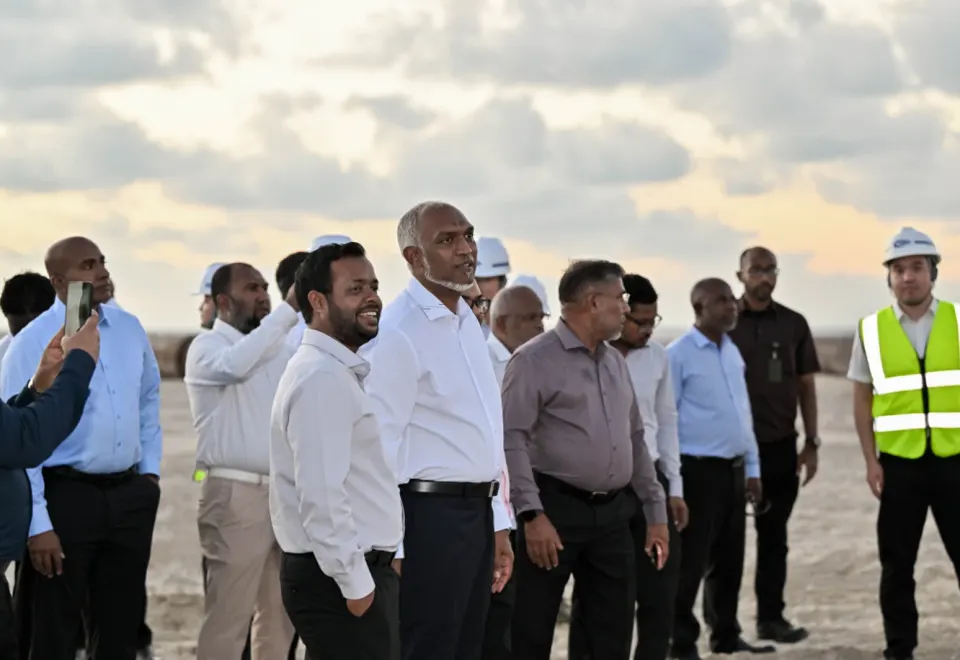
Its timetable has slipped. The link from Malé to Gulhifalhu was originally due by March 2026. In August 2026, the government said the project was 76% complete, after the President walked across the newly joined section between Malé and Villimalé, and it is now targeting completion by the end of 2027. Until it opens, Gulhifalhu's plot holders can't move in.
The neighbours: Villimalé and Thilafushi
Gulhifalhu sits between two very different islands.
Villimalé (Villingili), about 2 kilometres west of Malé, is the capital's quiet residential district. It covers just 0.27 square kilometres and had 6,755 residents in 2022. It was a resort when it opened in 1973, and is now a popular weekend escape for Malé families, with a public beach and a ferry that runs around the clock. For Gulhifalhu's future residents, Villimalé will be the nearest established community, and the first stop on the bridge towards Malé.
Thilafushi, on the other side, was created from a long lagoon called Thilafalhu after a government decision in December 1991, and received its first rubbish in January 1992. For decades it has been the capital's landfill, taking hundreds of tonnes of waste a day, and since 1997 land there has been leased for industry: boatbuilding, cement packing, gas bottling and warehouses. It is now the planned site of the Greater Malé commercial port. A previous government had also decided, in 2015, to move the port to Thilafushi, but that plan wasn't completed.
So Gulhifalhu's homes will sit next to a growing port and industrial zone on one side, and a residential island on the other. How the land use plan separates housing from industry will matter a great deal to the people who live there.
Timeline
- 2018: President Yameen announces the Villimalé 2 housing project for the lagoon.
- May 2020: Boskalis begins reclamation, mainly to make room for a new commercial port.
- 2021: the High Court halts the project on an environmental activist's petition.
- Early 2024: President Muizzu moves the port plan to Thilafushi.
- 2024: the Supreme Court overturns the injunction, and reclamation is completed in July, at about 150 hectares.
- 2025: the land use plan is amended again, 3,520 plots are assigned in a draw, and the first land registrations are issued.
- August 2026: the Thilamalé Bridge reaches 76%, with completion targeted for the end of 2027.
What Gulhifalhu suggests about Ras Malé
The two projects are different in scale. Ras Malé's planned land, at about 1,009 hectares, is more than six times Gulhifalhu's. But Gulhifalhu offers some useful lessons:
- Land comes first, links come later. Gulhifalhu's land was finished in 2024, but residents still can't move in until the bridge opens. Ras Malé's transport links haven't been decided yet. The government has only just begun a transport master plan. See our report on the transport plan.
- Plans change. Gulhifalhu went from housing project to port to housing again within a few years. Ras Malé's land use plan hasn't been published, and the Eagle Hills waterfront has already changed what part of it will be.
- Paperwork takes time. Plot holders in Gulhifalhu have waited for registration and handover long after the land was made. Families waiting for Ras Malé plots should expect a similar sequence.
- The environment pays. Gulhifalhu cost a protected reef. Ras Malé's reclamation has brought complaints about sediment and bait fishing grounds. See Ras Malé's environmental impact.
- Process matters. Gulhifalhu's contract was criticised for being awarded without a tender. The Eagle Hills deal for Ras Malé has faced similar questions. See our report on the PSIP rules.
For a history of all the land made around the capital, from the airport runway to Ras Malé, read a short history of reclaimed land in Greater Malé.
Questions people ask
Where is Gulhifalhu? ⌄
Is Gulhifalhu the same as Gulhi? ⌄
Is the new port being built on Gulhifalhu? ⌄
When can people move to Gulhifalhu? ⌄
Sources
- Gulhifalhu · Wikipedia
- Malé Commercial Port Project Shifts From Gulhifalhu to Thilafushi · MV Republic, 2024-01
- 3,520 land plots in Gulhifalhu assigned in draw · PSM News
- Public criticism mounts over repeated amendments to the Gulhifalhu Land Use Plan · Raajje.mv, 2025-05-19
- Housing Ministry issues new land registries for Gulhifalhu · SeeMV, 2025-07-12
- President Muizzu walks across newly connected Malé–Villingili section of Thilamalé Bridge · The Maldives Standard, 2026-08-30
- Thilamale' Bridge progress update · PSM News
- Thilamale' Bridge Project forward with 9% progress · PSM News
- MPL initiates Gulhifalhu reclamation project to relocate Malé commercial harbour · Corporate Maldives
- Thilafushi · Wikipedia
- Villingili (Malé) · Wikipedia
- Thila Malé Bridge reaches 76% completion, opening targeted for December 2027 · The Maldives Standard