Live Here
Ras Malé's Eco-City Plans: Renewable Energy and Climate Resilience
Ras Malé has been sold as the Maldives' first eco-city: raised above the sea, powered only by renewable energy, and built for walking, cycling and electric transport. Here is what the government has actually committed to, where it's written down, and what hasn't been decided yet.
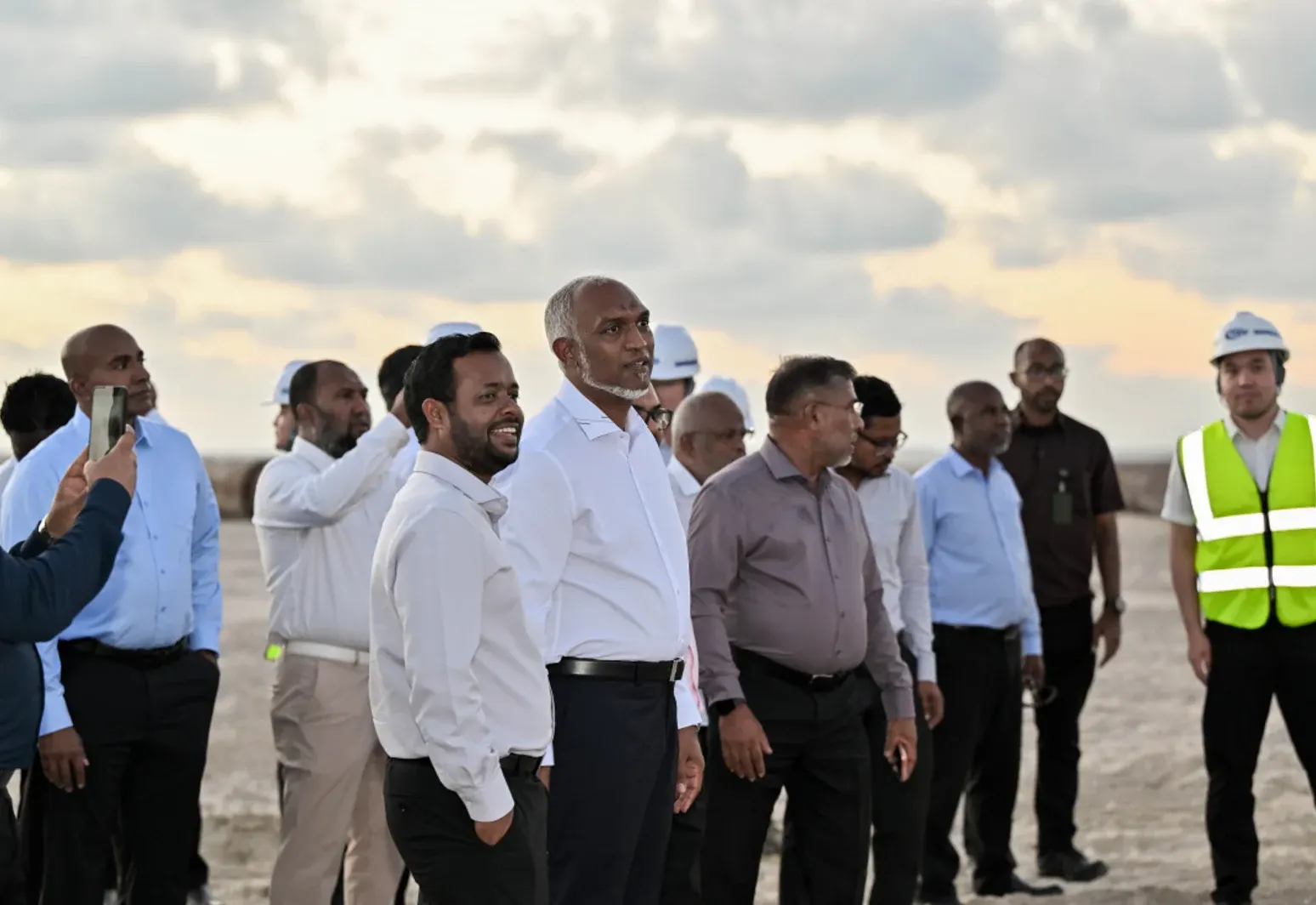
From the start, Ras Malé has been presented as more than a housing project. The government calls it an eco-city: a carbon-free, climate-resilient city on new, higher land, meant to show how a low-lying island nation can grow safely. This guide sets out what has been promised, where those promises are written down, and how far they've got. For the project as a whole, see What is Ras Malé?
In short ⌄
- At the launch in December 2023, the President promised a zero-carbon, safe island powered by renewable energy, with clean-energy vehicles.
- The government's brief for the master plan sets targets of more than 300,000 residents within 20 years, running exclusively on renewable energy.
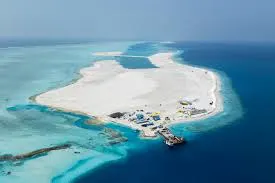
- The land is being raised 2 metres above sea level at the edges and 3 metres at the centre.
- No master plan has been published, so the eco-city design is still a set of goals rather than a plan.
The promise at the launch
At the ceremony starting the reclamation on 18 December 2023, President Mohamed Muizzu said Ras Malé would follow a "zero-carbon, safe island" concept, in line with his presidential pledge. According to the President's Office:
- the city would be powered by renewable energy
- vehicles in Ras Malé would run on environment-friendly or clean energy
- all its facilities would be built using eco-friendly methods
- the land would be raised about 3 metres at the centre and 2 metres at the edges, above the height set for a safe island under international criteria
HDC's project page repeats the goals. It describes an environment aiming for zero carbon, transport and infrastructure that prioritise renewable sources, and an inclusive design with accessible roads, public spaces and buildings.
The master plan brief
The most detailed statement of the eco-city goals is the government's terms of reference for the Ras Malé master plan. The Ministry of Finance and Planning put the work out to tender in October 2025 (project TES/2025/C-005), seeking a leading international urban planning firm. The brief describes Ras Malé as a planned net-zero, carbon-free and fully sustainable city, meant to set a global benchmark for climate-resilient design. It sets four aims:
- accommodate more than 300,000 residents within the next 20 years
- operate exclusively on renewable energy systems
- achieve carbon-neutral mobility within the island
- strengthen resilience to climate change and disaster risks
It also lists what the master plan must include:
- Green and blue infrastructure: mangrove buffers, wetlands, lagoons, biodiversity corridors and coastal protection.
- Transport that prioritises electric public transport, walking and cycling, with less dependence on cars.
- Utilities built around renewable energy grids, smart water and waste management, and digital systems.
- Conservation areas and ecological buffers to protect biodiversity and guard against climate hazards.
- Compact, mixed-use, high-density development to reduce the city's environmental footprint.
- Smart-city tools, including a "digital twin" model of the city and real-time management systems.
The brief asks for climate vulnerability assessments covering sea-level rise, storm surges, flooding and coastal erosion. It also says any coastal protection or marine works must be designed to minimise disruption to marine ecosystems, navigation and links between islands.
Where the master plan has got to
The brief set an ambitious schedule. Monthly reports were to start in November 2025, a draft land-use plan was due by February 2026, and the final master plan by June 2026. The deadline for firms to express interest was 14 October 2025.
As of October 2026, we haven't found a published master plan, or an announcement of which firm, if any, was appointed. Critics, including a Maldives Independent columnist, have asked where the master plan is, particularly for the land outside the Eagle Hills district. Until it appears, the eco-city remains a set of goals rather than a design.
The parts already decided
Some of the climate case is already being built into the land itself:
- Height. Ras Malé is being raised 2 to 3 metres above sea level. In one of the lowest-lying countries on earth, that height is central to the climate case.
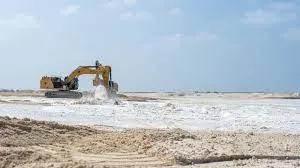
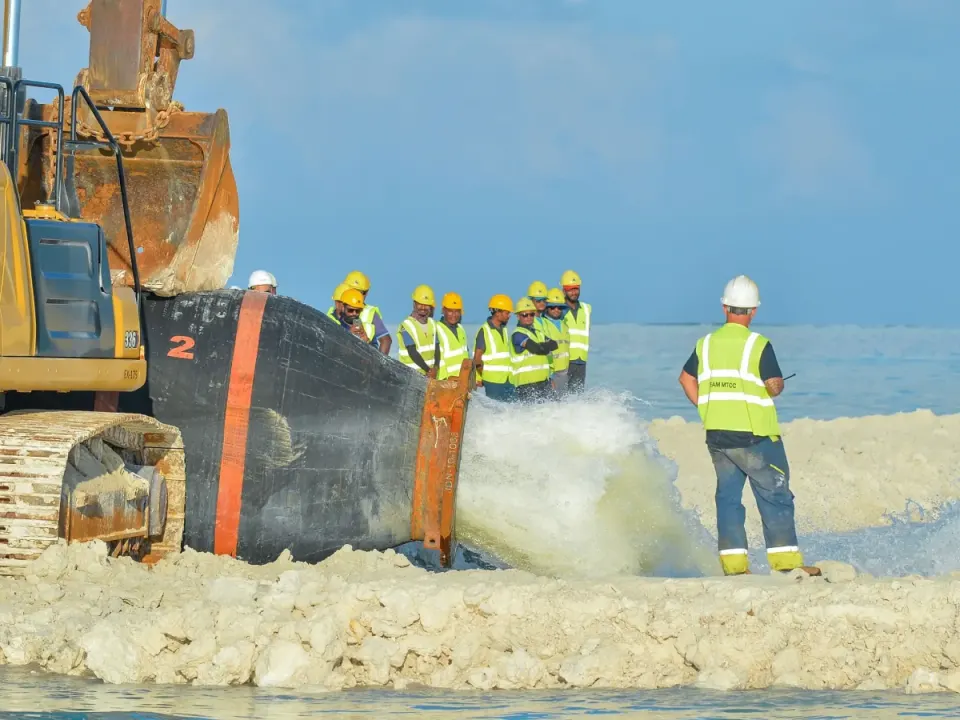
- Coastal protection. The official name of the work is the Rasmalé Land Reclamation and Coastal Protection Project. Finished sites, like Site J, move on to coastal protection works.
- No more dredging for the waterfront. Eagle Hills says its 500-hectare district will be built only on land already reclaimed, with independent marine monitoring.
A benchmark next door
Hulhumalé, the reclaimed city next to the airport, offers a comparison. Its master plan, revised in May 2025, describes "an island city" with intelligent, innovative and sustainable development at its heart. It sets aside about 30% of the land for green space and sport, and about 30% for housing. It aims to put green space, schools and mosques within a five-minute walk of every neighbourhood. Ras Malé's brief goes further on energy and transport, but it will be judged against what Hulhumalé already offers. Read more in Ras Malé vs Hulhumalé.
The tension
The eco-city label sits uneasily with how the land is being made. Reclaiming about 1,009 hectares means burying most of a lagoon. In early 2026, satellite images showed dredging plumes across large parts of South Malé Atoll, and fishermen and dive operators reported damage. The government argues the trade-off is worth it, because the country needs safe, high land, and the President's Office calls the reclamation the Maldives' largest climate adaptation project. Our article on Ras Malé's environmental impact sets out both sides.
Energy: the hardest promise
Running a city of hundreds of thousands of people "exclusively" on renewable energy is an ambitious goal, and the plans haven't yet said how it will be met. The brief asks for renewable energy grids and a net-zero framework, but there is no published plan for solar capacity, storage or backup power. A January 2024 agreement with China Machinery Engineering Group covers water and electricity for Ras Malé and Gulhifalhu, but its details haven't been released. This is the promise most worth watching, because it will shape everything from electricity bills to building design.
Transport without cars
The goal of carbon-neutral mobility fits Ras Malé's island setting. A compact city built for walking, cycling and electric public transport needs fewer roads and less parking. Links to Malé are being studied separately in a transport master plan. Options include express ferries and hydrofoils, an undersea tunnel and an airstrip.
What it means for residents
If the goals hold, life in Ras Malé could look quite different from Malé: higher ground, more green and blue space, quieter streets and cleaner power. It could also mean rules for homes and businesses, such as energy standards, limits on private cars or requirements to connect to shared systems. Families planning to build should watch for these. See our guide to building a house on a Ras Malé plot.
What to watch
- Publication of the master plan, and whether the 300,000-resident and 100%-renewable targets survive it.
- An energy plan showing how the city will be powered.
- Building rules for plots, including any green standards.
- The outcome of the transport master plan.
- Details of the water and electricity agreement with China Machinery Engineering Group.
- Whether the mangrove buffers, wetlands and conservation areas in the brief make it into the final plan.
Questions people ask
Is Ras Malé an eco-city? ⌄
How high is Ras Malé above sea level? ⌄
How many people will live in Ras Malé? ⌄
Sources
- President Dr Muizzu declares that Ras Malé will develop as a zero-carbon, safe island · The President's Office, 2023-12-18
- Rasmale (Maldives Eco City) project page · Housing Development Corporation
- Consultancy Services for the Preparation of Rasmale' Master Plan: terms of reference · Ministry of Finance and Planning, 2025-10
- Consultancy Services for the Preparation of Rasmale' Master Plan (TES/2025/C-005) · Government Gazette, 2025-10-04
- Rasmalé: A good deal would have nothing to hide (opinion) · Maldives Independent, 2026-10-18
- EXCLUSIVE: Rasmalé land reclamation in full swing · Dredging Today, 2025-11-13
- Eagle Hills signs $12 billion Maldives waterfront deal · Gulf News, 2026-09-21
- President champions climate adaptation abroad as dredgers blanket atoll in sediment · Maldives Independent, 2026-02-12
- Maldives signs with Chinese company to develop municipal facilities in Rasmale' and Gulhifalu · The Edition, 2024-01-12
- Government statement on the Maldives Waterfront and Marina · Khulaasaa, 2026-09-30
- HDC announces changes to Hulhumale' Master Plan · The Edition, 2025-05-26