Progress
Why Ras Malé's Progress Figures Don't Always Agree
In the same month, Ras Malé was reported as 43% and about 60% reclaimed. Neither figure was necessarily wrong. Here is why progress numbers differ, from different totals to site-level percentages, and how to read the next one you see.
If you follow Ras Malé in the news, the progress figures can be confusing. In December 2025, one report said the reclamation was 30% complete. In March 2026, the President said nearly 500 hectares had been reclaimed. In late June 2026, the President put progress at about 60%, while a tender notice the same week quoted HDC as saying 43%. By September, the figure was about 70%.
In short ⌄
- Ras Malé's progress has been reported as 30%, 43%, about 60% and about 70% at different times, sometimes in the same month.
- The total keeps changing: figures are measured against 1,009, 1,100, 1,150 or 1,153 hectares, depending on the source.
- Some percentages describe a single site or contract, not the whole city. MACL's '30%' in December 2025 was its own Site A.
- 'Reclaimed' can mean sand placed, or land finished with shore protection. Our tracker shows each figure with its date and source.
These numbers don't necessarily contradict each other. They often measure different things. This guide explains the main reasons, so you can read the next figure with more confidence. Our progress tracker lists every official figure with its date and source.
The figures so far
Here are the main published figures, in date order:
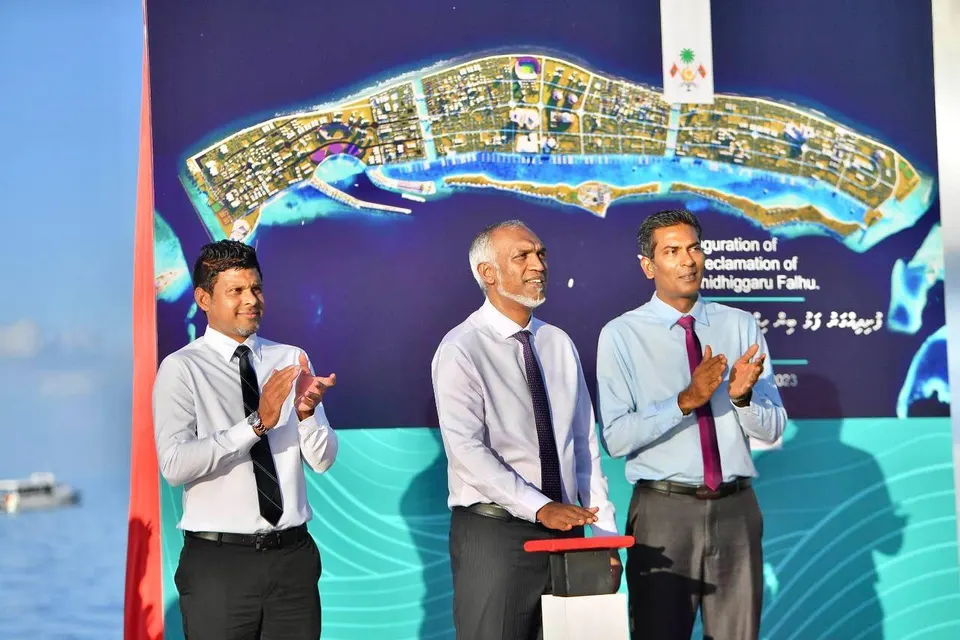
- 18 December 2023: reclamation begins. The first contract covers 29 hectares at Site J.
- 2024 to 2025: reports cite 101 hectares, then 129 hectares, reclaimed, out of 1,009 hectares planned.
- 24 December 2025: the airports company MACL says its work is 30% complete, with 41 hectares reclaimed at Site A, where it started on 1 December.
- 31 March 2026: President Mohamed Muizzu says nearly 500 hectares have been reclaimed, out of a total of 1,150 hectares.
- 29 June 2026: the President says reclamation is about 60% complete but has slowed because of fuel costs.
- 30 June 2026: a report on the master plan tender quotes HDC as saying 43% of the planned 1,150 hectares is complete.
- 26 September 2026: the President says about 70% has been reclaimed, and describes the finished area as about 1,100 hectares.
Reason 1: the total keeps changing
A percentage depends on what you divide by, and the total area of Ras Malé has been given in at least four ways:
- 1,009 hectares: the planned land in the environmental impact assessment and in most HDC material;
- 1,100 hectares: the President's description of the finished area in September 2026;
- 1,150 hectares: the figure used at the launch, in the master plan brief and in the March 2026 update;
- 1,153 hectares: the size of Fushidhiggaru lagoon itself.
The difference matters. 500 hectares is about 43% of 1,150, but about 50% of 1,009. So a report saying "43%" and one saying "half" could be describing the same amount of land.
There's a further twist. The Eagle Hills waterfront is to take about 500 hectares, roughly half the island. If future updates report the waterfront's land and the housing land separately, each will come with its own total, and its own percentage.
Reason 2: some figures describe one site, not the city
Ras Malé is being reclaimed as 12 sites, labelled A to L, with different contractors. (One 2026 report referred to 11 designated sites.) Contractors often report progress on their own contract.
The clearest example is MACL's update in December 2025. It said the reclamation was 30% complete, with 41 hectares reclaimed. That was 30% of MACL's own work at Site A, where 137.5 hectares were planned, not 30% of Ras Malé. By February 2026, MACL reported 116 hectares at Site A, or 84%. Read as a city-wide figure, it would have badly understated progress, since several other sites had already been filled by then.
When you see a percentage, check whether it comes from the government, from HDC, or from a contractor, and which site it refers to. Our guide to Ras Malé site by site lists the published figures for each one.
Reason 3: "reclaimed" can mean different things
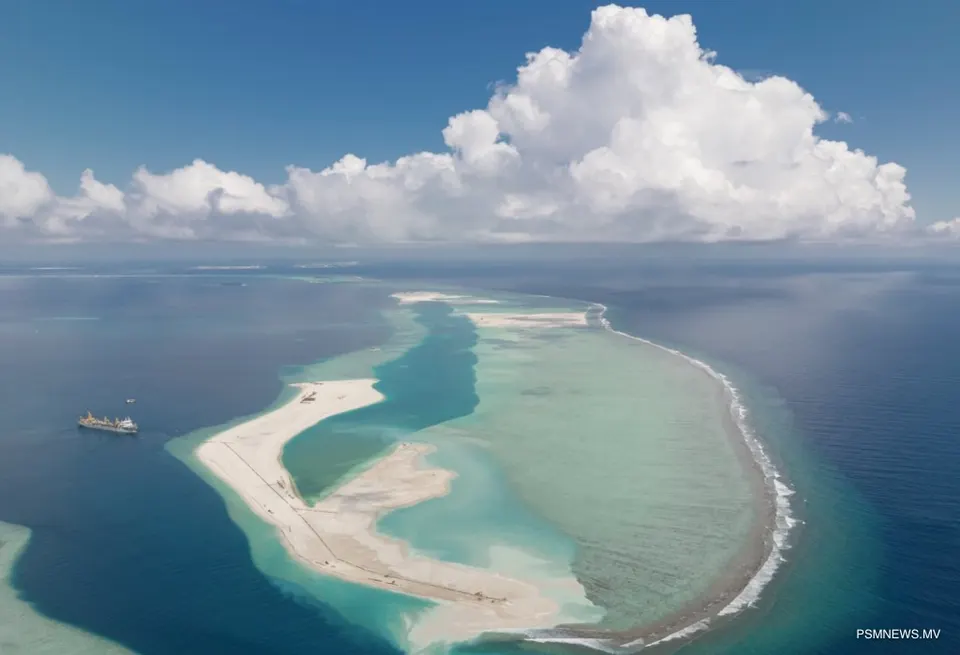
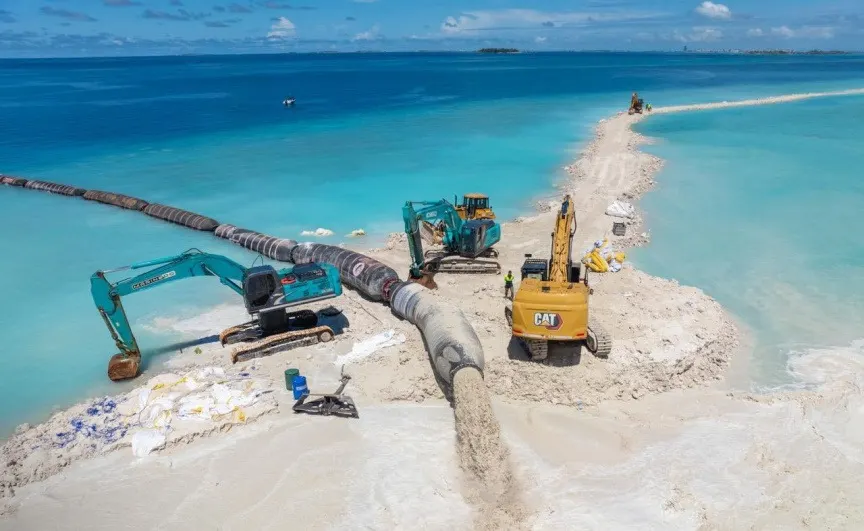
Making land happens in stages. Sand is pumped into an area enclosed by a temporary bund, then built up to the target height, left to settle and compacted, and finally protected along its edges with rock or concrete. Our guide to how land reclamation works explains each step.
A site can be described as reclaimed when the sand is in place, or only when it has reached its final height and has shore protection. A figure that counts sand placed will always run ahead of one that counts finished land. Official statements rarely say which they mean.
Reason 4: timing and rounding
Progress moves fast when a big dredger is working. The largest ship on the project, the Cristóbal Colón, has a hopper capacity of about 46,000 cubic metres, and reports during 2025 and 2026 described several hectares being added in short periods. A figure collected at the start of a month can be well out of date by the end of it, and figures are often quoted weeks after they were measured.
Figures given in interviews or speeches are also usually rounded. "About 60%" and "about 70%" are statements, not survey results. They are useful for the direction of travel, but shouldn't be compared to the last percentage point.
The June 2026 puzzle
The clearest clash came in late June 2026. On 29 June, Dredging Today reported the President as saying reclamation was about 60% complete. On 30 June, a report on the master plan tender quoted HDC as saying 43% of the planned 1,150 hectares was complete.
The reasons above could explain much of the gap. HDC's 43% matches the President's own March figure of nearly 500 hectares out of 1,150, so it may simply have been an older number. The President's 60% may have counted sand placed rather than finished land, or used a smaller total. Neither source explained its method, so we can't say for certain.
It's not just progress: other numbers vary too
The same pattern runs through almost every Ras Malé figure:
- Homes. The long-term target is usually given as 65,000 homes. One report described about 11,000 land plots and more than 26,000 housing units. The President has said 25,000 plots will come from Ras Malé in total, with 15,000 in the first round of Housing for All, and not all of those are in Ras Malé.
- People. Official figures for the eventual population range from about 150,000 to more than 300,000, the target in the master plan brief.
- The Eagle Hills project. Reports have valued it at US$12 billion for a first phase and up to US$20 billion in total.
- Hulhumalé, for comparison. Even the size of Hulhumalé's first phase is given as 188 hectares in some reports and about 194 hectares in others.
None of this means anyone is being dishonest. Big projects change as they go, different documents are written at different times, and figures are often repeated long after they've been updated. It does mean you should always check the date and the source.
What would make the figures clearer
The simplest fix would be a regular, official progress table: for each of the 12 sites, the planned area, the area filled with sand, the area at final height, the length of shore protection finished, the contractor, and the date of the survey. Publishing it alongside satellite images, which already show the project's outline clearly, would let anyone check the numbers. Until something similar is published for Ras Malé, every percentage should be read as an estimate.
How we handle it
On our progress tracker, we follow a few rules:
- Every figure has a date and a source. We say who said it and when.
- We separate percentages from hectares. A stated percentage and a hectare figure are shown separately, each with its own date, because they often come from different moments and sources.
- We don't calculate our own percentages from hectare figures and then present them as official.
- We show conflicting figures rather than choosing one.
Our page Ras Malé in numbers does the same for every other figure, from homes to costs.
How to read the next figure
When you see a new progress figure, ask:
- Who said it? The President, HDC, the housing ministry or a contractor?
- Is it the whole city or one site?
- What's the total? 1,009, 1,100 or 1,150 hectares?
- Is it a percentage or hectares? Hectares are easier to compare over time.
- When was it measured? And how long ago was it said?
What "finished" will mean
The government expects reclamation to be finished by the end of 2026. Even then, "finished" will need care. The last sand being pumped in is one milestone. Shore protection being completed around every site, the ground settling, and the land being surveyed and laid out for roads and plots are others. Families waiting for plots should watch for the later milestones, not just the headline percentage.
For what comes after reclamation, see when Ras Malé will be finished, and for the ships doing the work, see the dredgers building Ras Malé.
Questions people ask
How much of Ras Malé has been reclaimed? ⌄
Why do Ras Malé progress figures differ? ⌄
Was Ras Malé 30% complete in December 2025? ⌄
Sources
- Rasmale land reclamation reaches 30% completion, MACL says · MV+, 2025-12-24
- Housing for All initiative: Rasmale project reclaims nearly 500 hectares of land · Dredging Today, 2026-03-31
- Rasmale land reclamation faces temporary slowdown · Dredging Today, 2026-06-29
- Rasmale' masterplan consultancy opened for bidding · Maldives Ledger, 2026-06-30
- Eagle Hills project will not affect housing plans: President · The Edition, 2026-09-26
- 129 hectares reclaimed as Rasmale' eco-city project advances · TIO
- Rasmale': 101 hectares from 1,009 hectares reclaimed in seven months · SeeMV
- Fushidhiggaru first phase covers 29 hectares: EIA report · Atoll Times, 2023-12-19
- Fushidhiggaru reclamation begins; 'Ras Male an example to world' · Atoll Times, 2023-12-18
- Fushidhiggaru dredging project achieves 10 hectares in one week · Avas
- Rasmalé Site A reclamation reaches 84% completion · MMTV