Progress
Ras Malé in 2025: The Year Reclamation Sped Up
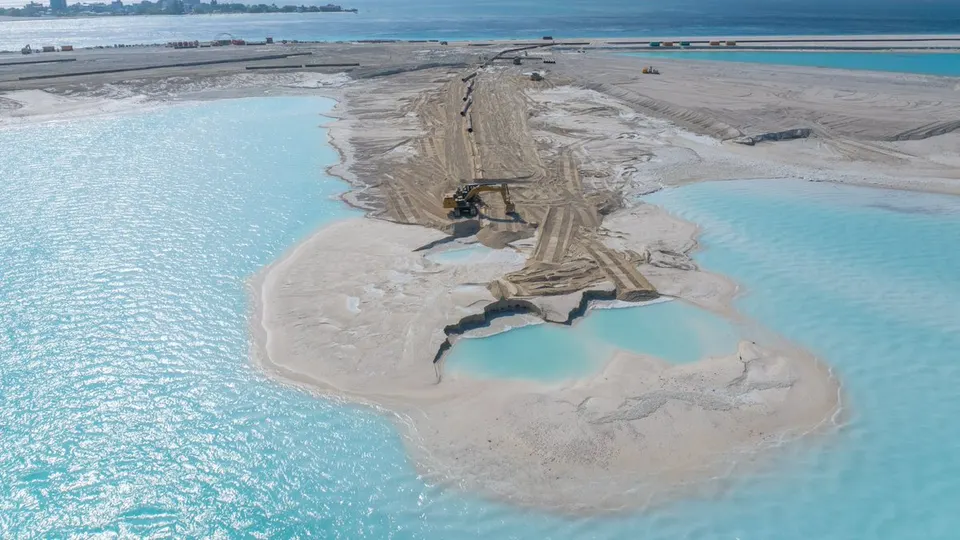
Ras Malé started 2025 with about 100 hectares of land and a contract heading for the rocks. It ended the year with new contractors, the biggest dredger in the country and a housing policy built around it. Here is what happened, month by month.
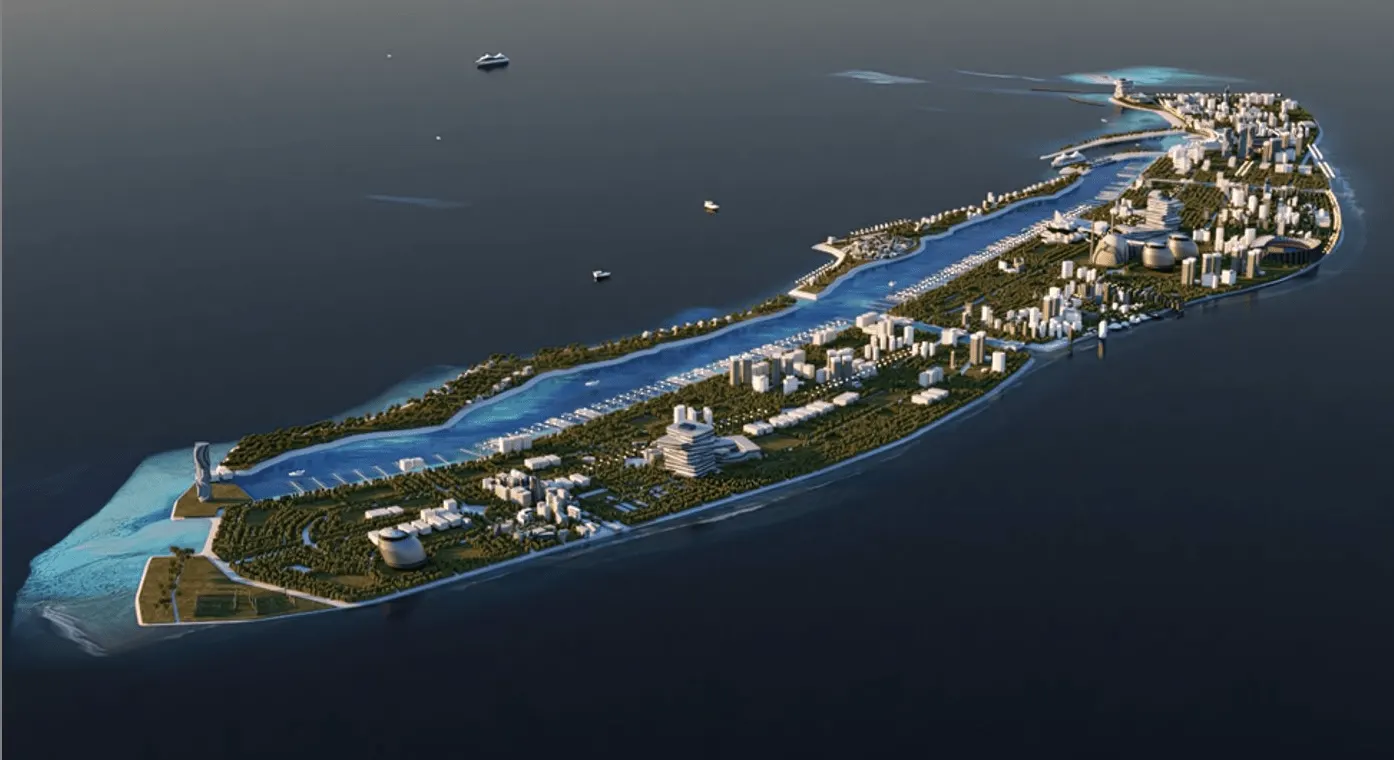
Ras Malé was launched in December 2023, but 2025 was the year it changed gear. The year began with only a small part of the lagoon filled, one contractor gone and another struggling. It ended with new contractors, much bigger ships, a housing policy built around the new land, and tenders for the city's master plan and transport links. This review sets out what happened, in order, with sources for every figure.
In short ⌄
- In January 2025, HDC agreed to pay CMC about US$21 million for the 29 hectares it had reclaimed at Site J.
- In July 2025, HDC ended CRCC's US$265.5 million contract. China Harbour (CHEC) took on Sites C and E in August, and the airports company MACL began Site A in December.
- Bigger dredgers changed the pace: China Harbour's Jun Yang 1 from August, and Jan De Nul's Cristóbal Colón, one of the largest in the world, from 1 December.
- In November 2025, the President announced Housing for All, with 15,000 plots in the first round and 25,000 to come from Ras Malé in total.
For the latest figures, see our progress tracker. For what came next, see when Ras Malé will be finished.
Where things stood at the start of 2025
By the beginning of 2025, Ras Malé had been under way for a year, and progress was slow:
- Site J, 29 hectares, had been reclaimed by Sri Lanka's CMC, the first contractor, whose contract was cancelled in May 2024.
- India's Mohan Mutha Exports was working on a group of sites including D, F, G and L. One 2024 report described Site D, about 264 hectares, as the only site with visible work, with its bund wall advancing slowly.
- China Railway Construction Corporation (CRCC) held a US$265.5 million contract, signed in July 2024, to reclaim 352 hectares across five sites in 18 months.
- After Parliament removed the project's 2024 budget allocation, the work was being paid for through HDC, which had been reported in September 2024 to be taking out a large loan.
January: settling with CMC
In late January 2025, reports said HDC had agreed to pay CMC about US$21 million (about MVR 323 million), in instalments over 12 months, for the 29 hectares at Site J, and that CMC would not go to arbitration. A government official said CMC would no longer receive the land it had originally been promised as part of its contractor-financed deal, reported as 70 hectares. The government described the payment as for completed work, not compensation. Our guide to the contractors covers the deal in full.
June: the subcontractor goes to court
In June 2025, the Civil Court ordered CMC's company, CMCC, to pay the state-owned MTCC about US$1.6 million (MVR 24 million), within a month, for dredging 10 hectares as a subcontractor. MTCC had finished the work by December 2023 and had tried to recover the money for most of 2024. CMCC accepted the debt but said it was waiting for HDC to pay it.
July: CRCC's contract ends
In July 2025, a year into its 18-month contract, HDC ended CRCC's agreement because the reclamation hadn't progressed as required. CRCC had received a US$13.2 million advance, and went on to claim US$9.4 million for work done. An independent assessment later valued the work at US$6.7 million. The board's decision on that claim, in August 2026, is covered in our report on the CRCC claim.
Losing the largest contract meant the sites it covered had to be reassigned, and new contractors had to bring in their own ships.
August: China Harbour arrives
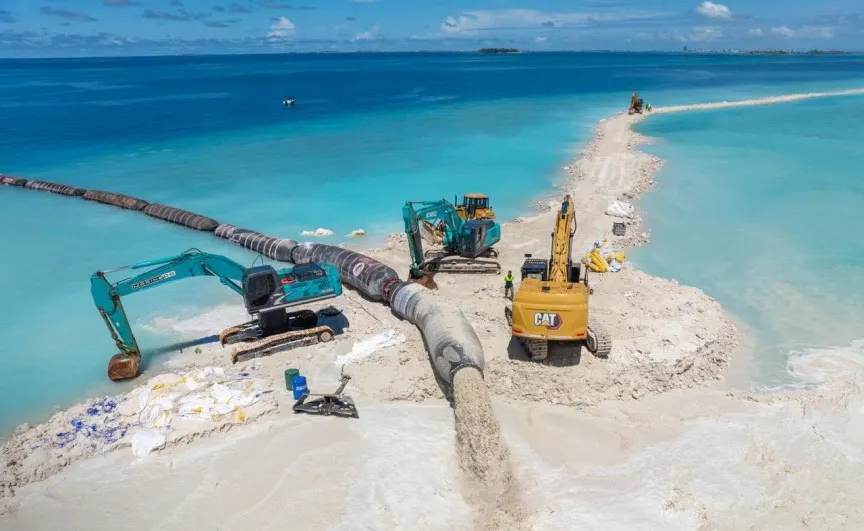
On 2 August 2025, China Harbour Engineering Company (CHEC), the company that built the Sinamalé Bridge between Malé and the airport island, was hired to reclaim Sites C and E, a total of 265 hectares. Work began later that month with its dredger, the Jun Yang 1, which carries about 21,000 cubic metres of sand per load, around twice the capacity of the earlier vessels.
By August, the group of Sites D, F, G and L worked by Mohan Mutha had reached 100.6 hectares.
September and October: loans and a master plan
Two announcements in the autumn looked beyond the dredging:
- September 2025: the government launched the Hiyaavehi housing finance programme, offering construction loans at 5% a year, aimed at families who would build on government plots. In October, Bank of Maldives launched its own Hiyavehi financing product. See our guide to building a house on a Ras Malé plot.
- October 2025: the Ministry of Finance and Planning invited firms to prepare the Ras Malé master plan, with expressions of interest due on 14 October. The brief targeted more than 300,000 residents within 20 years, running only on renewable energy. See the Ras Malé master plan.
November: Housing for All, and a new target date
November was the busiest month of the year:
- 12 November: the President inspected the site. HDC put reclamation at about 183 hectares, and the government said it expected reclamation to be finished in March or April 2026.
- 13 November: Site J was reported complete, with Site L at 25.53% and Site C at 20.09%, and more dredgers promised for December.
- 18 November: the President announced the Housing for All policy, with 15,000 land plots in the first round and 25,000 plots in total to come from Ras Malé. Applications opened in January 2026. See our guide to housing in Ras Malé.
- November: Parliament passed an amendment to the Special Economic Zones Act creating a "sustainable township" category for projects worth more than US$500 million, with a property transfer tax of up to 4%. The President ratified it in December. Its 4% transfer tax matches the 4% buyers' fee later announced for the Eagle Hills waterfront, though the government says the Eagle Hills agreement itself gets no tax breaks under the Act.
- November: the government presented the Pearl Residence scheme abroad, with a launch announced for April 2026. See the Pearl Residence programme.
December: the giant dredger
The year's turning point came at the very end. On 30 November 2025, Jan De Nul's trailing suction hopper dredger Cristóbal Colón, one of the largest in the world with a capacity of about 46,000 cubic metres, arrived at Ras Malé. The next day, 1 December, the state-owned Maldives Airports Company Limited (MACL) began reclaiming Site A, a planned 137.5 hectares.
The effect was immediate. MACL reported 23 hectares by 18 December and 41 hectares by 24 December, about 30% of Site A in under a month. By February 2026, Site A had reached 116 hectares, and by the end of March 2026 the President said nearly 500 hectares had been reclaimed across the project. Our guide to the dredgers explains why ship size matters so much.
December also brought two other milestones:
- The transport plan. On 8 December, the finance ministry invited consultants to prepare a Ras Malé transport master plan and feasibility study, with the deadline later extended to 31 December. See our report.
- Environmental complaints. The Environmental Regulation Authority said it had received complaints about dredging outside permitted areas and during sand-mining alerts, and warned of legal action, without naming anyone. Satellite images in early 2026 showed sediment plumes across much of South Malé Atoll. See Ras Malé's environmental impact.
What 2025 changed
Looking back, three things stand out.
Ship size beat everything else
For most of the first two years, progress was limited by small dredgers and contractors who struggled to deliver. Once the Jun Yang 1 and then the Cristóbal Colón arrived, hectares that had taken months began to appear in weeks. The single most important decision of 2025 may have been bringing in the biggest ships available.
The state took a bigger role
The original plan had been for contractors to finance the work in exchange for land. By the end of 2025, the project was being paid for through HDC, and the fastest work was being done by MACL, a state-owned company. That gives the government more control, but also puts more of the cost and risk on the public balance sheet. The year's bills showed what that means: about US$21 million to CMC for 29 hectares, a US$13.2 million advance to CRCC that was never fully earned, and an HDC loan whose size still hasn't been disclosed. See who pays for Ras Malé.
The housing promise became concrete
Before November 2025, Ras Malé's housing was a general promise. Housing for All turned it into numbers, with 15,000 plots in a first round and 25,000 in total, and a timetable. When applications closed in June 2026, 58,505 people had applied for plots and flats. The pressure to finish the land, lay it out and hand it over has grown ever since.
The targets that slipped
2025 also added to Ras Malé's list of missed deadlines. In November, the government expected reclamation to finish in March or April 2026. In December, MACL aimed for early 2026. Both were missed: in June 2026, the President said the original date wouldn't be met because of rising fuel costs, and that reclamation would instead finish within 2026. By September 2026, he put progress at about 70%.
Questions people ask
What happened at Ras Malé in 2025? ⌄
How much of Ras Malé was reclaimed by the end of 2025? ⌄
Which dredger sped up Ras Malé? ⌄
Sources
- HDC to pay $21 million to CMCC for Rasmale dredging · Atoll Times, 2025-01-28
- CMC decides not to go to arbitration after USD 21 million settlement deal · Adhadhu, 2025-01-26
- Court orders CMCC to pay MVR 24M to MTCC for Rasmale dredging · Atoll Times, 2025-06-19
- HDC board accepts CRCC's $9.4 million Rasmale work claim despite lower valuation · Atoll Times, 2026-08-11
- China's CHEC joins Ras Malé reclamation as government expands contractor base · PSM News, 2025-08
- Rasmalé reclamation work starts with Chinese company on site · MMTV, 2025-08-21
- Hiyaavehi low-interest housing loan scheme · MMTV, 2025-09-11
- BML launches "Hiyavehi" financing program · The Edition, 2025-10-09
- Consultancy Services for the Preparation of Rasmale' Master Plan: Terms of Reference · Ministry of Finance and Planning, 2025-10
- President inspects progress of Rasmalé Land Reclamation Project · The President's Office, 2025-11-12
- Exclusive: Rasmalé land reclamation in full swing · Dredging Today, 2025-11-13
- 25,000 land plots to be issued from Rasmale': President · The Edition, 2025-11-18
- President ratifies amendment to Special Economic Zone Act enabling sustainable township development · Invest Maldives, 2025-12-14
- Exclusive: Jan De Nul's TSHD Cristóbal Colón starts its work on Rasmalé · Dredging Today, 2025-12-01
- Rasmale' land reclamation reaches 30% completion, MACL says · MV+, 2025-12-24
- Rasmale' Transport Master Plan: request for expressions of interest · Government Gazette, 2025-12-08
- Rasmalé Site A reclamation reaches 84% completion · MMTV, 2026-02-12
- Housing for All initiative: Rasmalé project reclaims nearly 500 hectares of land · Dredging Today, 2026-03-31
- Rasmalé land reclamation faces temporary slowdown · Dredging Today, 2026-06-29